
January 10, 2026
With great excitement he read the name, Amenhotep II, that was clearly inscribed on a statuette at the entrance to the tomb which his archaeological team had just unearthed in the Valley of the Kings in 1898. With one colleague, one candle and infinite excitement, Victor Loret made his way purposefully down the ancient tunnel before him, first entering a two-pillared room in which he discovered a frightful sight, a mummy lying in a boat.
He pushed on to the next room, an even larger one with six pillars and artwork that depicted a king in the presence of a deity. At the back of the room Loret descended a short flight of stairs to a lower level—and there it was! The sarcophagus of Amenhotep II, confirmed by inscriptions on funerary statuettes that were laid out before it, though mysteriously one lone statuette strangely bore a different name, Webensenu. The lid of the sarcophagus had been removed previously by long-ago looters, but when the Frenchman peeked inside by candlelight he could see the pharaoh’s coffin, and later upon opening the coffin, Loret would find a mummy wrapped in a funeral shroud that again bore the name of Amenhotep II, eliminating all doubt that he had discovered the tomb of the pharaoh whom most Bible-believing teachers and pastors believe to be the pharaoh of the exodus.
In a separate chamber to his right Loret next discovered three mummies lying on their backs, the middle one being that of a child or young teen, perhaps eleven to fifteen years of age. Its head was completely shaved except for a single lock of long black hair that grew out of the upper right side of his head. Loret immediately recognized this as the hairstyle of Egyptian princes, and a nearby jar bore a prince’s name, Webensenu, and the words, “king’s son of his body.” Since the tombs of pharaohs were sealed permanently upon their death, it follows that Webensenu died before his father and had been placed in the tomb with him.
Now here’s where it becomes especially intriguing. Exodus 9:10 reads, “Then they took ashes from the furnace and stood before Pharaoh, and Moses scattered them toward heaven. And they caused boils that break out in sores on man and beast.” I promised you intrigue and you shall have it, for when Loret removed the pharaoh’s body from the tomb and had it examined by a fellow Egyptologist and renowned anatomist, the report came back in part, “The skin over the whole body is thickly studded with small projections or tubercles [that are] certainly unusual.” In fact, these tubercles have not been found on any other mummies.
But here’s where the intrigue deepens even further, for Exodus 12:29 reads, “And it came to pass at midnight that the LORD struck all the firstborn in the land of Egypt, from the firstborn of Pharaoh to the ….” Wait, what? That’s right! The pharaoh lost a son that night, a royal prince who died before ascending the throne, and it’s possible that we even know his name—Webensenu. Admittedly many Egyptologists believe that two sons of Amenhotep II died before their father and that the other son, also called Amenhotep, was actually the crown prince, but the point remains the same.
The boil-like sores of the pharaoh and the presence of a young prince in his father’s tomb should certainly give one pause. Together they suggest to me that we have it exactly right! A boil-plagued pharaoh prematurely lost his firstborn son. The Bible may not definitively provide their names, but history and an Egyptian tomb sure seem to!
Daniel McCabe
Trivia
What Old Testament prophet speaks specifically about the Messiah standing on the Mount of Olives and splitting it in two?
A. Isaiah
B. Jeremiah
C. Malachi
D. Zechariah
Life in the Land: Mamad
Following the Gulf War of 1993 the Home Front Command began requiring a mamad for all new construction in Israel, including homes, apartments, daycares, office buildings, hospitals and schools. Mamad is a Hebrew acronym, formed from “merchav mugan dirati,” which means a “reinforced security room.” In short mamads are bomb shelters, protecting Israel’s citizens from air raids, chemical or biological threats, and missile or rocket attacks.
The concrete walls and ceilings of mamads are much thicker and stronger than normal construction. They have blast-proof steel doors and windows capable of resisting shockwaves and shrapnel, and they’re outfitted with a separate ventilation system capable of protecting against chemical attacks.
The mamad in each home or apartment typically doubles as a bedroom, office or storage area, but all family members quickly find shelter there when air raid sirens warn them of danger. The residents of settlements near Gaza or Lebanon may have no more than fifteen seconds to find cover in their mamads whereas those living in Jerusalem have up to a minute and a half. Communities with older homes offer public shelters, but of course it takes more time to reach them and some people have been injured or even killed while running to one.
The Home Front Command provides an app, which anyone can download, that notifies residents of any dangers and notifies them when it is safe to exit their shelters. Some mamads are stocked with non-perishable food, water, extra phone chargers and even sleeping bags or mats in case residents are forced to remain there for an extended period of time.
I can’t imagine living every day under the constant threat of attack, but most Israelis take it in stride. For them it is a normal part of life.
Daniel McCabe
History: The Jerusalem Cross
On Tuesday, July 15, 1099 A.D. Christian combatants of the First Crusade conquered Jerusalem, killed its Jewish and Muslim inhabitants and inaugurated the Kingdom of Jerusalem. One week later the crusaders chose Godfrey of Bouillon to rule over their new kingdom, but out of respect for the kingship of Jesus, Bouillon instead preferred the title, “Defender of the Holy Sepulcher,” a reference to the church that marks the traditional location of both the crucifixion and burial of Jesus. At that time the crusaders also adopted a symbol for their kingdom, known to most as either the Crusader cross or the Jerusalem cross, which has become a popular symbol for Christianity in general, especially within Roman Catholicism.
Most modern representations of a Christian cross are drawn with a vertical stroke that’s longer than its horizontal stroke and with the horizontal stroke placed at the upper end of the vertical stroke whereas a Jerusalem cross is drawn with strokes of equal length that intersect at their midpoints. Altogether the latter uses five crosses—one central cross and four smaller crosses positioned inside the four quadrants formed by the central cross. Additionally the arms of the central cross are drawn with small crossbeams at each end, but you will see many stylistic differences.
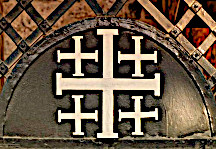
According to various traditions, the central cross represents either Jerusalem or Jesus; the four smaller crosses represent the four disciples or the four corners of the world; and the five crosses in total represent the five wounds of Jesus—two in his hands, two in his feet and one in his side. Do you like the design of the Jerusalem Cross? Would you consider having one tattooed on your hand or right wrist as is quite popular with Coptic Christians after having made their pilgrimage from Egypt to Jerusalem?
Daniel McCabe
On Location:: Artistic Locations in Israel
I have seen a lot of beautiful art throughout the country. Much of it was made by God himself in nature. I think of places like the Sea of Galilee, the unique wonder of the Dead Sea, the wildlife of the Hula Valley and many other beautiful forests, deserts and mountains.
I have also seen many great works of human art in several churches. One that I think of often is a recent construction, that of the church in Magdala on the western shore of the Sea of Galilee. Magdala is an ancient fishing village, the hometown of Mary Magdalene. A church was built there in 2014 called the Duc in Altum, which is a Latin phrase taken from Luke 5:4, where Jesus told Peter to “put out into the deep” and in obedience Peter cast his fishing net into the deep water and caught a surprising number of fish after having caught nothing all night long.
The architecture of the church itself is impressive, yet not overstated. There are three areas within the church that stick out to me. You first enter the Women’s Atrium, which commemorates women of faith throughout the ages. Seven pillars bear the names of women connected with Jesus’ ministry and an eighth is deliberately left blank to symbolize all women of faith. It is really fun to sing inside the atrium because its domed roof does wonders with the acoustics as the sound reverberates all around you.
You can then walk from the Women’s Atrium into a light and airy modern church sanctuary, the Boat Chapel, named for its pulpit, which is shaped like an ancient fishing boat. When you sit on one of the benches, facing the boat pulpit, you see the waters of Galilee beyond the large glass wall behind the boat, and your eye level is such that it looks as if the boat is floating on the Sea, just like Peter’s did two thousand years ago. That visual is artistic enough, but when you look around the room you will also see banners of Jesus’ twelve apostles. Eleven of them feature something that the twelfth does not—a halo! The one without a halo is none other than Judas Iscariot who was not saved and redeemed from his sins.
But for me the most significant piece of artwork in the entire church is found in the basement. Underneath the Boat Chapel is a room called the Encounter Chapel. When you walk into this room you come face to face with a large mural that always takes my breath. Although the painting captures a busy street scene, you can only see the feet of the people. There are some in sandals and Roman boots, but in the middle of the mural you see one notable person’s feet—those of Jesus. What is remarkably different from everyone else’ feet is the lone hand reaching out to touch the feet of Jesus, for the town of Magdala is a possible location of a well-known biblical miracle, one that I must confess to tearing up every time I read it. It is one of only a few passages in the Gospels that always has this effect on me. Each synoptic Gospel records the story of a woman who suffered form an issue of blood for twelve years without relief, yet her condition only grew worse even though in desperation she had spent everything she had on help from local physicians. Her impressive faith and humility now brought her to Jesus who healed her with great power and compassion. The mural in the Encounter Chapel captures this moment well, and that alone is worth your time to make a visit to the Duc in Altum in Magdala.
Adam Keim
From the Archives: The Millennial Temple
Six times in seven verses the Apostle John describes a future, 1000-year period of time during which Jesus will reign physically on the earth (Revelation 20:1-7). Just imagine! The Bible says a great deal about conditions during this coming age, including longer life spans, worldwide peace, the transformation of animal life, and even blooming deserts, but for now we’ll focus only on temple worship during the Millennium.
The prophet Isaiah predicted that “in the latter days … all nations shall flow to [the LORD’s house, the millennial temple]” (Isaiah 2:2). The prophet Haggai likewise predicted that all nations will come to this temple, adding that it will be more glorious than any temple the Jews had ever seen (Haggai 2:7-9). Ezekiel spent several chapters in his prophecy, describing in detail the dimensions, parts and contents of this beautiful, last days temple (Ezekiel 40-48; cf. Isaiah 60:13) as well as the obligation of those living at the time “to keep its whole design and all its ordinances, and [to] perform them” (Ezekiel 43:11), including required animal sacrifices and pilgrimages (Isaiah 56:7; Jeremiah 33:18; Zechariah 14:16-19).
The Old Testament sacrifices described in the Law of Moses were never prescribed as a cure for sin, but rather to point the worshipper to his sin with the subsequent hope of a coming Deliverer who alone could take away his sin (Hebrews 10:4). Likewise, the sacrifices prescribed during the Millennium will point to Jesus, “the Lamb of God,” who provided sin’s cure at Golgotha and now reigns as king (John 1:29).
The massive millennial temple and its courts will cover about one square mile of land, marked by a tree-lined, healing stream that will emanate from the threshold of the temple (Ezekiel 47:1, 7). There is no mention of the ark of the covenant, a veil, cherubim or even a high priest in the millennial temple, but the glory of God will return to it, for Israel has returned to her God after a prolonged period of unbelief, and he “will dwell in their midst forever” (43:2, 9).
Daniel McCabe
Answer to the Trivia
D. Zechariah