

July 26, 2025
Faith Lessons from Luke 7
#1: If others with so little spiritual knowledge can have such faith (a centurion, a child, a new believer), then surely we who know the Bible and have studied it, perhaps for years, should have more faith.
In what way do we need to trust the Lord? Perhaps our prayer should be, “Lord, increase our faith” (Luke 17:5).
#2: Men judge one another by their merits, but God judges us by our faith.
- The Jews—he is “deserving.”
- The centurion—“I am not worthy.”
- Jesus—he has “great faith.”
- Ephesians 2:89, “Faith … not of works”
Trivia
What is the name of Israel’s famous selfdefense system?
- A. Derekh Eretz
- B. Kol Nidrei
- C. Krav Maga
- D. Tilun Olam
(Find the answer below)
On Location: The Mardigian Museum
If someone mentions a twentieth century world war, with concentration camps, death marches, mass deportations, and countless people persecuted and murdered for their faith. What comes to mind? The murder of six million Jews by the Nazis during World War II? Absolutely! But that’s not at all that I was thinking.
From 1915 to 1917, during the heart of World War I, the Ottoman Empire pressured or brutally forced roughly one million, predominantlyChristian Armenians from their ancestral land in the eastern part of the empire. Many Armenians were robbed, raped, or forced to convert to Islam, and many more lost their lives. Death toll estimates range from 600,000 to 1.5 million in what history has now labeled “The Armenian Genocide.”
In 301 A.D. Armenia became the first nation to adopt Christianity as its state religion, eleven years before Emperor Constantine of Rome followed suit. Armenians have maintained a continuous presence in the Holy Land since the fourth century, and when mapmakers divided Jerusalem’s Old City into four quarters in the nineteenth century, they notably designated the southwest quarter of the city as the Armenian Quarter. Although regularly overshadowed by the Christian, Muslim and Jewish quarters, which are dominated by the Church of the Holy Sepulcher, the Dome of the Rock and the Western Wall, respectively, the Armenian Quarter, the smallest and quietest of the four, nevertheless harbors unique surprises of its own.
For example, a new museum has been recently renovated just off Armenian Patriarchate Street in the Old City, formally known now as the Helen and Edward Mardigian Armenian Museum of Jerusalem. When entering Jaffa Gate, bear right at the Citadel and pass the colorful ceramics shops, the Armenian Tavern and finally the Cathedral of St. James. Just before the road takes a hard left, heading toward Zion Gate, look for the museum on your left.
On display there you’ll find a replica of Gutenberg’s printing press, ancient manuscripts, modern art, photography which documents Armenia’s presence in Jerusalem, stunning Armenian mosaics, tile and pottery, and sadly a special section devoted entirely to the 1915 Armenian Genocide. Rarely visited by tourists to Jerusalem, it is a hidden gem inside the Old City walls that tells both the joyful and tragic story of Armenia’s history and culture.
Daniel McCabe
Archaeology: A Lovely Oil Lamp
Last winter, just days before Hanukkah, the Israeli Antiquities Authority announced the discovery of a 1700 year old clay oil lamp near the Mount of Olives, in Jerusalem. This unbroken lamp features exquisite artistry and only light soot marks at the wick end. Although dating to the fourth century, perhaps 250 years following the destruction of the Jewish temple by the Romans in 70 A.D., the carvings on the lamp depict an incense shovel from the temple, the menorah of the temple and also a lulav, the frond of a date tree, which Jewish worshippers wave during the annual celebration of Sukkot in order to remember that their forefathers once lived in tents for forty years before entering the Promised Land.
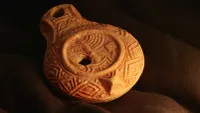
The lamp is now on public display at the newly built Jay and Jeanie Schottenstein National Campus for Archaeology in Jerusalem. “Let your light so shine before men that they may see your good works and glorify your Father in heaven” (Matt. 5:16).
Scripture Study: The Song of Moses
I enjoy reading the prayers and songs of faithful people in the Bible because we can learn a lot from them about who God is and about how God contends for His children. So, let’s look at faithful Moses who sang a song to God after the Lord brought Israel through the Red Sea while escaping from Pharaoh’s hot pursuit.
We read about this in Exodus 15:1, “Then Moses and the people of Israel sang this song to the LORD, saying, ‘I will sing to the LORD, for He has triumphed gloriously. The horse and the rider He has thrown into the sea. The LORD is my strength and my song, and He has become my salvation. This is my God, and I will praise Him, my father’s God, and I will exalt Him. The LORD is a man of war. The LORD is his name.’”
We don’t often think of God as a God of war, but Moses had just experienced God’s military victory over Pharaoh, which Moses continues to describe in v. 4, “Pharaoh’s chariots and his host, He cast into the sea, and his chosen officers were sunk in the Red Sea. The floods covered them. They went down into the depths like a stone. Your right hand, O LORD, glorious in power, Your right hand, O LORD, shatters the enemy in the greatness of Your majesty. You overthrow Your adversaries. You send out Your fury. It consumes them like stubble. At the blast of Your nostrils the waters piled up. The floods stood up in a heap. The depths congealed in the heart of the sea. The enemy said, ‘This is Pharaoh. I will pursue. I will overtake. I will divide the spoil. My desire shall have its fill of them. I will draw my sword. My hand shall destroy them.’”
But, of course, we know Pharaoh did not get to realize that intention, for Moses continues in v. 10, “You blew with Your wind. The sea covered them. They sank like lead in the mighty waters.”
This is really the point that Moses is getting to, and this is really what I love reading about, particularly songs of victory as well as prayers that focus on God’s greatness. Moses then says in v. 11, “Who is like You, O LORD, among the gods? Who is like You, majestic in holiness, awesome in glorious deeds, doing wonders? You stretched out Your right hand. The earth swallowed them. You have led in Your steadfast love the people whom You have redeemed. You have guided them by Your strength to Your holy abode. The peoples have heard and they tremble. Pangs have seized the inhabitants of Philistia. Now are the chiefs of Edom dismayed. Trembling seizes the leaders of Moab. All the inhabitants of Canaan have melted away.”
Here Moses is focusing on the people who Israel will encounter in the Promised Land and all the enemies of Israel that God will take care of, so to speak.
In v. 16 he adds, “Terror and dread fall upon them because of the greatness of Your arm. They are still as a stone till Your people, O LORD, pass by, till the people pass by whom You have purchased.”
Moses concludes by looking to a hopeful future.
“You will bring them in and plant them on Your own mountain, the place, O LORD, which You have made for Your abode, the sanctuary, O LORD, which Your hands have established. The LORD will reign forever and ever.”
So that’s just one of several examples of songs and prayers in the Bible that I think we can read to be encouraged and to learn what faithful people so long ago thought about the Lord.
–Adam Keim
Answer to Trivia question:
C. Krav Maga