

Flood Stories—Polystrate Fossils
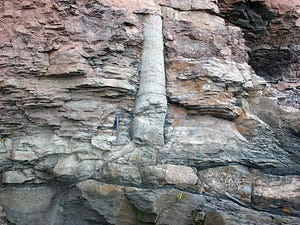
Let me first admit that I spent waaaaay too much time reading about this topic over the last several weeks for the amount of time that I’m giving it in this post. Perhaps there are others here (let me see a show of hands) who like me have gotten lost in a topic and you just couldn’t seem to find your way out of it. Well ….
Many Bible-believing scientists insist that polystrate fossils provide strong evidence, perhaps even irrefutable proof, for a global flood while evolutionary scientists brush aside their conclusions as myopic at best and junk science at worst. So what’s all the fuss?
Coined by proponents of a global flood, the term, polystrate fossils, has been summarily dismissed by evolutionists as both technically inaccurate and highly prejudicial though it hardly strikes me as an unreasonable description of fossils that penetrate more (poly-) than one strata (-strate) of sedimentary rock. A young earth is fatal to the theory of evolution, so any proposed evidence that challenges the necessity of millions of years to explain the formation of rock layers can quickly bring out the knives.
If one found a fossilized tree traversing multiple layers of strata, it might reasonably suggest that the layers were laid down quickly, thus potentially challenging evolutionary theory and even pointing perhaps to a catastrophic event as the cause, such as a global flood—which is why Bible-believing scientists find polystrate fossils so compelling—but evolutionists counter that perhaps it merely points to recurring local flood events that took place over a few decades and which progressively buried and fossilized the tree—or perhaps or perhaps or perhaps.
Sometimes the simplest explanations are the best, and given my admitted bias in favor of a global flood, I don’t find it difficult to see the reasoning behind an explanation for polystrate fossils that posits a global flood. So if you’re looking for something to read tonight before bed, take a look at this debate and weigh the evidence for yourself. You’ll find that the experts can explain it much better than I, and you might just find yourself getting lost in the debate.
-Daniel McCabe
Trivia (Answer below)
What is the name of the pilgrim in Chaucer’s Canterbury Tales who is said to have visited Jerusalem three times?
A. The Knight
B. The Merchant
C. The Monk
D. The Lady of Bath
Scripture Study: The Seed Plot of the Bible
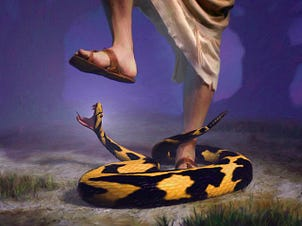
I first learned about Genesis 3:15 in Dr. McKinley’s Old Testament Survey class in the Fall of my freshman year at LeTourneau College while pursuing a degree in mechanical engineering. Does this verse sound familiar to you? Speaking to the serpent, God declared, “And I will put enmity between you and the woman and between your seed and her Seed; He shall bruise your head and you shall bruise His heel.”
On p. 5 of “Doc” McKinley’s book, “Scanning the Plan,” he included a paragraph entitled, “The Seed Plot,” referencing this verse and noting that it’s in this verse that we read for the very first time about the gospel in prophetic form, for in Genesis 3:15 we learn of God’s plan of deliverance for Adam and Eve after their fall into sin and in particular of God’s promise of a coming Deliverer who would make all things right again.
Here are Dr. McKinley’s “seven basic facts” that flow from this verse.
1. The future birth of a child—God tells Satan that there will be enmity between Satan’s seed and “her [meaning Eve’s] Seed.” Notice that Seed here is capitalized. Admittedly the Hebrew doesn’t use capital letters, but the editors of your Bible and mine want to emphasize that this birth will not be a normal one, for in hindsight we know that the child will be Jesus, God in human form. Dr. McKinley believes that this verse points to Jesus’ virgin birth because “it is man who bears the seed of procreation … not the woman,” yet the child is described as the seed of the woman alone. In any event, a child will be born who will deliver Adam and Eve from their sin.
2. The humanity of the child—the fallen couple should look for a human being, the offspring of the woman.
3. Open war between Satan and the child—my translation calls it enmity, but one should expect to see Satan’s intense attack on anyone associated with bringing this child into the world.
4. The child’s death—the verse reads, “…you shall bruise His heel.” The soldiers literally bruised the heel of Jesus when they nailed him to the cross, thus his bruised heel pictures his crucifixion and death.
5. The doom of Satan—though the heel of Jesus is bruised, it’s the head of Satan that will be bruised, suggesting that Jesus will overthrow Satan’s kingdom and thwart any plans Satan had to defeat him.
6. Personal conflict—two seeds or offsprings are contrasted, suggesting conflict between two parties, particularly Jesus Christ and the Antichrist.
7. Restoration—the bruising of Satan implies that the Seed of the woman will restore man to his original position before the fall.
What a beautiful gospel story told in just one verse!
-Daniel McCabe
Photography from Israel:
Psalm 23, “Surely Goodness and Mercy”
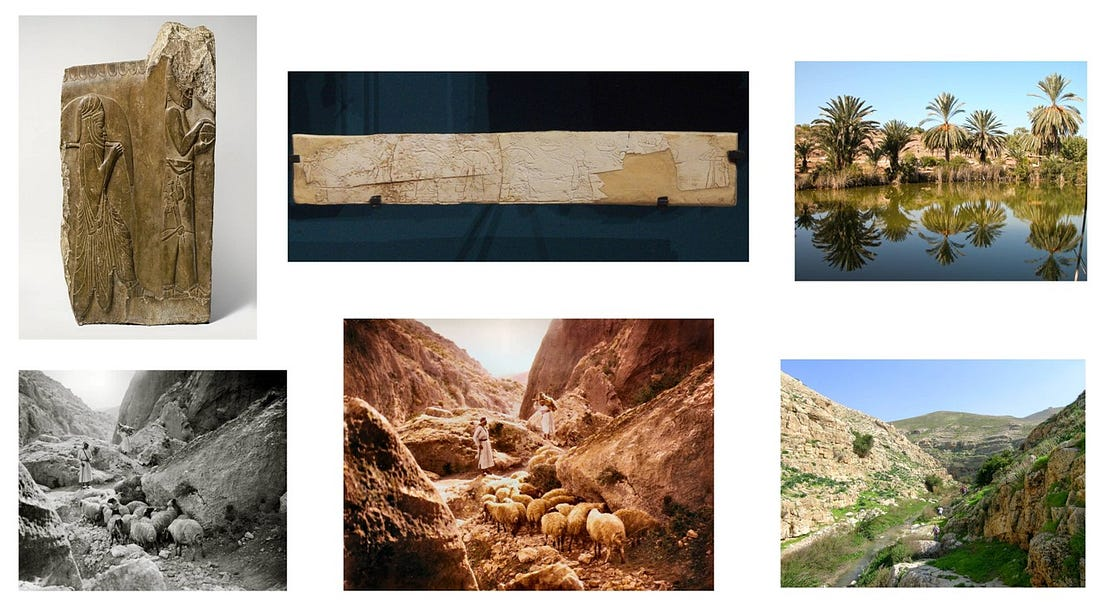
Here are some images that depict ancient and modern blessings.
1. A relief showing two servants bearing food and drink to their king, found at Persepolis in ancient Persia, dated to 358–338 B.C.
2. A depiction on ivory of a train of tribute-bearers from Nimrud in ancient Assyria, dated to 850–610 B.C.
3. A beautiful pool with date palms at Neot Kedumim in central Israel
4. A photograph of shepherds caring for their sheep in Israel, dated to 1900-1920
5. Another colorized photograph of the same date
6. Hikers in Nahal Perat, also known as Wadi Qilt, a dry riverbed east of Jerusalem
-Daniel McCabe
Christology—the Humanity of Jesus, part 2

et’s continue our study of the humanity of Jesus Christ by examining a couple of important theological terms, which demonstrate the importance of word order and specificity in the terms that we use. We know that Jesus was tempted in every way, yet without sin. In His humanity, in His human nature, Jesus is posse non peccare, which means “able to not sin.” In His divinity, He’s non posse peccare, which means “not able to sin.” Do you see the difference?
In His humanity He’s “able to not sin.” He has the capability to decide not to sin. Of course, theoretically He had the capacity to sin. The human Jesus could have conceivably committed a sin, but He never did and was never going to because He had the ability to always choose righteousness. In His divinity He’s “not able to sin.” He doesn’t even have the ability to sin because God cannot sin. God cannot possibly sin because sin by definition is anything that’s contrary to God’s character and will, and God is never contrary to His character and will. So the divine person doesn’t even have the capacity to sin.
Logically the temptations of Jesus had to be real temptations or else they wouldn’t be temptations. Jesus was tempted in every way to sin. So when He’s in the wilderness for forty days without having eaten, and the devil says, “Hey, turn these stones into bread,” the human Jesus really wanted to eat. But He had the ability to not sin, and He never fell into temptation.
Now here’s where we can connect our own experience to this. In our pre-saved state, in our fallen humanity, before we have heard the gospel, we are not able to not sin. Being slaves to sin, we’re bound to sin. We have to sin. We will sin. Yet, it’s still our fault. We can’t stand before God and insist, “It wasn’t really my fault!” Being slaves to sin, we sinned constantly, for it was our nature. Sin was our master. That, of course, doesn’t mean we sinned constantly, every second of every day. We could give to a charity. We could help old ladies across the street. We could think kind thoughts about other people. However, our lives were characterized by sin. We sinned all the time, for we were slaves to it.
On the other hand, as believers we are free from the bondage of sin. We have a new master. We now become able to not sin. We can always choose the righteous path. We have the ability to resist temptation and not fall into sin. In reality we still wrestle with the flesh. We still fall into temptation from time to time, but hopefully we sin less and less over time as we grow in our sanctification. Hopefully we choose righteousness and obedience to our Master Jesus more and more often. So pre-salvation we were not able to not sin. Post-salvation we are able to not sin, just like Jesus in His humanity was able to not sin, and though Jesus as the perfect Man never did, sadly we do. So, as you can see, depending on the order in which you put them, the words “able,” “not” and “sin” mean very different things.
-Adam Keim
Archaeology—the Pilate Stone
You know him best as the man who allowed the execution of Jesus to proceed even though he famously said of him, “I find no guilt in this man” (Luke 23:4). In his position as the Roman governor of Judea, Pontius Pilate had the authority to spare the life of Jesus, but even after his wife had a dream about Jesus’ innocence and his own interview of Jesus reinforced her conviction, Pilate “delivered Him to be crucified” (Matt. 27:26). The Ethiopian Orthodox Church believes that Pilate’s words about Jesus and his reluctance to fast track Jesus’ execution lead to only one conclusion—that Pilate became a Christian. They even venerate Pilate as both a martyr and a saint in contrast to the more common take that he spoke and acted solely out of political expedience.
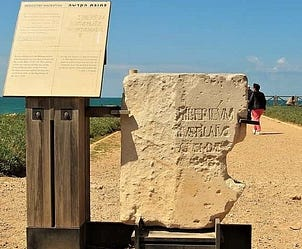
In any event whether his role in the trial of Jesus is that of a saint or a savvy politician, there is no meaningful disagreement regarding Pilate’s historicity and proper governmental title following a monumental find in 1961, known popularly as the Pilate Stone. Discovered in Israel in the port city of Caesarea on the coast of the Mediterranean Sea, this broken, carved block of limestone, measuring just over 2 feet tall and 2½ feet wide, bears the name of “[Ponti]us Pilatus, [Praef]ectus Juda[ea]e,” the Latin spelling which translates into English as “Pontius Pilate, Prefect of Judea.” In Latin prefect is a title that means roughly, “put in charge,” and the Bible rightly describes him as the “governor” of Judea (Matt. 27:2; Luke 3:1).
Evidently carved to dedicate a Roman building in Caesarea, perhaps even a temple in honor of Tiberius Caesar, the Pilate Stone dates to the time of Jesus in the first century. Yet again, the accuracy of the Bible has been corroborated—this time by a broken stone that points our attention back to the bitter-sweet account of our Savior, who on the night before his crucifixion broke bread with these wonderful words, “This is My body which is broken for you” (1 Cor. 11:24).
-Daniel McCabe
Answer to the Trivia
D. The Lady of Bath