Category Archives: Blogs

The Bedouin

The Bedouin: The People and Religions of Israel

Life in the Land: The Bedouin, part 1

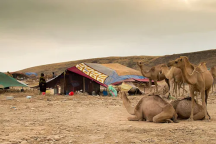
I saw my first Bedouin encampment flash by the right window of my tour bus in 1999 as we descended east along Highway 1 toward Jericho from Jerusalem. Is this how Abraham and the patriarchs once lived? How different from the life I’ve always known!

Bedouin means “desert dwellers” in Arabic, and it’s simply amazing how they can live in the harsh conditions of the Judean desert with barely two inches of rainfall a year, daytime temperatures routinely exceeding 100 degrees in the summer, and no electricity, running water and sewer, forced to travel from camp to camp throughout the year in order to find water and vegetation for themselves and for their goats, camels and sheep, yet they thrive.

They are known for their gracious hospitality, camel races, sword dances and poetry recitation. They’re perhaps best known, however, for selling camel rides to tourists at the Sea Level marker along Highway 1 and for having first discovered the Dead Sea Scrolls near Qumran. They have a fierce loyalty to their tribe, perhaps even stronger than their devotion to God, and although a small number of Bedouin are Christian, most identify as Muslim. They are Arabs, having migrated from the Arabian Peninsula between the fourteenth and eighteenth centuries.

More recently the Israeli government has encouraged the Bedouin to relocate to urban areas, most in southern Israel, but some in Galilee, where they are provided with free education and medical services. In fact almost half the total Bedouin population has relocated, though high unemployment, high crime, gang activity and rising Islamic fundamentalism have reshaped their ancient ways. The Bedouin have one of the highest birth rates in the world, growing at a pace of 5% annually, but at present they make up only 3% of the population of Israel. They have been granted full Israeli citizenship, but only 4% have graduated from high school and 1% from college. A few, however, have chosen to serve in the Israel Defense Force where they are often assigned to elite tracking units.

Daniel McCabe

Jericho: The Archaeologists Disagree

Scripture and Archaeology: Jericho, part 2

There have been three major excavations in the biblical city of Jericho. Oh, what a tangled web they weave!

Excavation #1: A German team from 1907-1911, led by Ernst Sellin, a distinguished biblical scholar with practical experience in archaeology, and Carl Watzinger, a trained secular professor of Classical archaeology who specialized in art, architecture and history. The team initially dated the destruction of Jericho to approximately 1400 B.C., which comports well with the biblical date of 1406, but twenty years later Watzinger revised his dating based on a reevaluation of the city’s pottery and stratigraphy to reflect a much earlier date of approximately 1600 B.C.

Excavation #2: A secular, British, Classical archaeologist named John Garstang who excavated from 1930-1936. He too assigned the date for Jericho’s destruction to 1400 B.C. after a particularly in-depth examination of its pottery. Although not a trained ceramicist by specialization he had a more widely acknowledged expertise of its usage in dating Near Eastern cultures than did Watzinger. Even so, Garstang’s dating of Jericho’s destruction has been almost universally ghosted by modern archaeologists who champion the dating of Kathleen Kenyon, Jericho’s third lead excavator.

Excavation #3: The British School of Archaeology under the direction of Kathleen Kenyon who excavated the “City of Palms” from 1952-1958. She assigned a date for the destruction of Jericho to no later than 1550 B.C., contradicting both Garstang’s findings and the biblical record which date it to around 1400 B.C. Kenyon’s primary argument for a sixteenth-century conquest of Jericho was based on the absence of any Cypriot pottery at the site, which had been reliably present at many other Levantine sites from the same period.

Now I’m no expert on pottery, though I’m admittedly quite fond of the Wallace and Gromit mug which I use here on my office desk to hold my pens and pencils, but what do experts say about the absence of Cypriot pottery as a dependable time marker in Near Eastern archaeology, the same experts, by the way, who have almost universally applauded Kenyon’s methods and findings at Jericho? Well, the American Journal of Archaeology, a formidable secular publication, actually cautions against treating the presence (or absence) of Cypriot pottery as a definitive chronological marker because its distribution can be uneven and context-specific. Other reliable sources also acknowledge that Cypriot pottery was largely absent outside of coastal trading zones, and last I checked Jericho is not so near the coast.

So why build the strength of one’s argument on the absence of something? My seminary professors often addressed this point in my own formal training, warning that it is unwise at best and perhaps even dangerous to lean on an argument from silence, and yet that appears to be exactly what Kenyon has done to the universal cheers of fellow archaeologists. Sure, she arrived at her date for the destruction of Jericho by examining other factors, but she admittedly found the absence of Cypriot pottery to be the tipping point in her evaluation of the city’s conquest.

But let me add this one final note. Bryant Wood, a leading archaeologist with Associates for Biblical Research, has studied all the pottery unearthed by Garstang as well as that by Kathleen Kenyon, and he finds abundant evidence of local Canaanite pottery consistent with a dating of 1400 B.C., including what he calls imitation Cypriot pottery.

In any event could it be that modern archaeologists are actually more biased than biblicists like myself in that they refuse to give proper weight to the biblical evidence for the ancient dating of events like the exodus and the conquest of Jericho even while attacking Christians for being biased? Some trained archaeologists have rightly questioned the speculative pottery analysis at Jericho in favor of the proven reliability of the biblical text, and I find myself standing with them.

Daniel McCabe

Trivia

What are the names of the three major religions that consider Jerusalem a holy city?

A. Hinduism, Buddhism, Judaism

B. Islam, Christianity, Judaism

C. Islam, Zoroastrianism, Christianity

D. Judaism, Christianity, Sikhism

Watching Jesus Pray, Part 5

Luke 22:39-46,

Ok, so far we’ve seen that prayer was a habit for Jesus and that prayer keeps you from sinning. But from watching Jesus pray, we also learn to pray wisely.

III. Learn to pray wisely (v. 42).

a. It’s o.k. to pray for tough times to pass. Jesus did! In v. 42, Jesus prays, “Father, if it is Your will, remove this cup from Me; nevertheless, not My will, but Yours, be done.”

b. Notice too that Jesus didn’t pray just to get his way. I’ve prayed like that. In the past I’ve prayed that God would let me date a certain girl. Or be able to afford a certain car. Or be able to get over my sickness before Tuesday. Things like that.

There’s certainly nothing wrong with asking God for things we desire. He may certainly be pleased to answer your prayers, but we are wise to remember that he knows more about what you need than you know.

c. Have you ever prayed for the wrong thing? Let me tell you a great story about a man who learned an important lesson about how to pray wisely.

“A man was being pursued by a hungry lion. Feeling the beast’s hot breath on his neck and knowing that his time was short, the man prayed as he ran. He cried out in desperation, ‘O Lord, please make this lion a Christian.’ Within seconds the frightened man became aware that the lion had stopped the chase. When he looked behind him, he saw the lion kneeling, lips moving in obvious prayer. Greatly relived at thTrivia

What are the names of the three major religions that consider Jerusalem a holy city?

A. Hinduism, Buddhism, Judaism

B. Islam, Christianity, Judaism

C. Islam, Zoroastrianism, Christianity

D. Judaism, Christianity, Sikhismis turn of events, and wanting to join the lion in prayer, the man now started walking toward the lion. But as the man drew closer to the lion he heard him praying, ‘And bless, O Lord, this food for which I’m exceedingly grateful!’”

Pray wisely!

There are so many other things I see in this passage that we simply don’t have the time to explore in depth.

For example, we see that God sends comfort and strength when we pray (v. 43).

We see that it is important to be persistent in prayer (v. 44).

Finally, we learn that it is important to support others with our prayers (vs. 44-45).

We’ve learned so much from simply watching Jesus pray!

I hope I’ve encouraged you to pray.

Daniel McCabe

Scripture Study: Theology Proper-God’s Essence (continued)

God alone is self-existent. He owes His existence to nothing and to no one. He just simply is, and one of my favorite Scripture combinations (Exodus 3 and John 8) makes a wonderful connection point between the Old Testament and the New. When Jesus tells the crowd in John 8, “Before Abraham was, I Am,” He’s quoting Exodus 3. When God reveals His name to Moses, He says, “I Am Who I Am.” That was the best name He could give Himself. He’s just the one who is. Nobody else is. Only God is. He is self-existent. He has no master and He owes His existence to nothing or to no one else.

God is indivisible and is always one. We see this in the great Shema, “Hear, O Israel, the Lord, your God. The Lord is one.” One God—there are not three, and we’ll get to the Trinity soon. There’s one God. He is infinite. He’s beyond man’s ability to grasp, yet I love this so much about God. We can never fully comprehend Him because we are limited. We are the created. He is the creator. We are finite. He is infinite. We are temporal. He is eternal. I think when we are with Him in the new heavens and new earth, in the infinite state, we can be with Him for ten quadrillion years and still never fully comprehend Him. He’s so far beyond us. We can, however, apprehend Him. We can learn about Him and that’s why we study Scripture, in order to know God better and to know Him as deeply as we possibly can. Our intellect can only grasp so much, but on some level we can still apprehend Him.

Now let me address the best and classic example of this—the Trinity. God is triune. That is what Scripture presents. He exists in one essence while subsisting in three persons. We can never fully comprehend this. God is so unique. The Trinity is so unique. There’s nothing else like God. It’s beyond our comprehension to fully wrap our minds around Him no matter how arrogantly we might think to ourselves, “I can get it if I just have enough time. I’m smart enough to figure it out.” No, we are not. We can’t!

You aren’t going to find the word Trinity in the Bible. But what we see in Scripture is a clear presentation that the Father is God, the Son is God, and the Holy Spirit is God. All three persons of that Trinity, or subsistencies, if you will, all three persons are fully God. In two future series on Christology and Pneumatology we’ll talk about the personhood of the Son and the Holy Spirit. But in the Great Commission found in Matthew 28:19 we see this Trinitarian expression in reference to baptism. All three persons are fully God—the Father, the Son and the Holy Spirit. All three are equal in essence and nature, and ultimately all persons of the Trinity are worthy of the same adoration.

But all three are also distinct from one another. Scripture is clear on this. There’s a distinction between the Father and the Son, the Son and the Holy Spirit, and the Holy Spirit and the Father. Even so there exists only one true God. Though each member of the Trinity is equal, there is an economical order of priority in their function, the function of God. There is a role that the Father has taken on as well as the Son and the Holy Spirit distinctly, and we see this throughout Scripture. Since the Trinity is unique, well-intentioned metaphors to describe it will always break down at some point. You may have heard different attempts to describe the Trinity. How can it be explained? Some say that the Trinity is like the sun in outer space in that it has heat, light and fire—three aspects, but only one item. Some people liken the Trinity to an egg that has the yolk, the white and the shell. Again, one item, but three distinct parts. If we press each metaphor, however, they will always break down at some point because nothing is quite like the Trinity.

But there is one decent illustration of the Trinity, known as the Trinitarian shield. It is a triangle with one person of the Trinity placed at each point. It doesn’t matter at which point you place them, but there’s the Father, the Son, and Holy Spirit at each corner of the triangle. Now at each side of the triangle you could write the words “is not,” so the Son “is not” the Father, the Son “is not” the Holy Spirit, and the Holy Spirit “is not” the Father. Then from each point you can draw a line towards the middle of the triangle to a circle that says God, and on each line that goes from a point to the circle you can write the words “is,” for the Father “is” God, the Son “is” God, and the Holy Spirit “is” God.

The point is this. God is unique. He transcends our thoughts and our ways. We can never fully comprehend or get Him. That’s a big part of what makes Him God. If we could get all that is God and fully comprehend Him, He wouldn’t really be God. We would then be equal with God, and we are not. We cannot be. So even though the word Trinity is not in Scripture, it clearly presents the picture that God is triune.

Adam Keim

Answer to the Trivia

B. Islam, Christianity, Judaism

Who We Are

Shalom Y’all Ministries is a 501(c)(3) organization, and all gifts to our ministry are tax-deductible. SYM was formed in 2021 to teach the Bible and lead tours to Israel. Our teaching and presentations feature the acronym S-H-A-L-O-M, which means “peace” in Hebrew.

Our Mission

To teach and encourage those who love the Bible, the land of the Bible and the people of the land and to lead educational tours to Israel that forever change the way you read your Bible and worship the Lord

Our Prayer

“The Lord bless you and keep you; the Lord make his face shine upon you and be gracious to you; the Lord lift up his countenance upon you and give you peace” (Numbers 6:24-26).

Shalom Y’all!

OVERWHELMED AND UNDER EQUIPPED

Week Forty-Eight, 2025

“And after him was Shamgar the son of Anath, which slew of the Philistines six hundred men with an ox goad: and he also delivered Israel.” (Judges 3:31)

Sometimes, God so under-equips us that when we have victory, we will know it was through Him and not by our own power and equipment. Have you ever had that feeling that you were facing a task so overwhelming that with all you had available, you could never do what you needed to do?

Years ago, as an election approached, my name was on the ballot. As the campaign rolled on, things got nothing but worse. The campaign was falling apart, and I was sinking in the polls. Even my advisors said there was no way I could win.

I got on my knees beside my bed and prayed not just to win, but to win with such a victory that it would be obvious it was God’s victory, not mine. I prayed that the resources I needed would be provided by God. We won by a wide margin. God showed that it was not by my might, but by His.

We learn about Shamgar in Judges 3. It was his lot to be under-equipped for the task. He had no traditional weapons to be used in the battle; all he had was an ox goad. It was, as it was named, a stick used to move oxen along their way. It was a wooden tool, approximately eight feet long, fitted with an iron spike or point at one end, which was used to spur oxen as they pulled a plow or cart. It often had an iron scraper at the non-pointed end to clear clods of earth from the plowshare when it became weighed down.

Judges 3 begins by identifying those undefeated nations that would test Israel’s reliance on the Lord. Specifically, they would be used to test new generations of Israelites who grew up without knowing war. The nations were placed all around Israel. The Israelites were trapped and seemingly destined to fall—and then along came Shamgar.

Shamgar fought where and when he was – He did not give in to fear. He did not wait for better circumstances. He just took his stand for God and won the victory. Shamgar fought with what he had – No matter how weak you think your weapons are, put them in the hand of God and watch Him do great things with them.

So, no matter what odds are against you, take what you have and place it in God’s hand, and see how He can win your battle.

Sometimes True Stories

“For we are his workmanship, created in Christ Jesus for good works, which God prepared beforehand, that we should walk in them” (Ephesians 2:10).

Over 100 years ago, a group of fishermen were relaxing in a Scottish seaside inn. One of the men gestured wildly, and his arm struck the serving maid’s tea tray, sending the teapot flying into the whitewashed wall. The innkeeper surveyed the damage and sighed, “The whole thing will have to be repainted.”

“Perhaps not,” offered a stranger. “Let me work with it.” Having nothing to lose, the proprietor consented. The man pulled pencils, brushes, and pigment out of his art box. In time, an image began to emerge: a stag with a great rack of antlers. The man inscribed his signature at the bottom, paid for his meal, and left. His name: Sir Edwin Landseer, the famous painter of wildlife.

In his hands, a mistake became a masterpiece. God’s hands do the same, over and over. He draws together the disjointed blotches in our lives and renders them an expression of His love.

What do you see when you look into the mirror… only bits and pieces? How much of Jesus do you see in the mirror? Are we willing to allow God’s artistic best to shape our lives into something we can’t even imagine? Be blessed.

– 0 –

A pastor was ten minutes into his sermon when he noticed his young son in the balcony with a peashooter. He was leaning over the balcony and popping people in the head. As the pastor prepared to deliver a very public scolding to his boy, the seven-year-old son hollered out, “You keep preaching, Dad, and I’ll keep ’em awake!”

Quotes You Can Use

To be an effective public witness, the Christian must be grounded in the Word, and his Christianity must not be restricted to the walls of the church. —Edgar Aponte

While parents are not solely responsible for the blessing of their children, they can certainly set the tone for a life of integrity by teaching about the importance of a life with Jesus Christ. —Tony Ferguson

Resurrection is not reconstruction. —Wayne Burks

Faithful Christians will face trials and discouragement—but God’s presence, provision, and purpose are at work. Don’t quit before the blessing comes. Don’t let trials and opposition blind you to God’s kindness and provision. Don’t walk away before the blessing arrives. —Edgar Aponte

Never lose hope. Just when you think it is over, God sends you a miracle.

Indeed, the safest road to hell is the gradual one—the gentle slope—soft underfoot, without sudden turnings, without milestones, without sudden signposts. —C.S. Lewis

The difference between stupidity and genius is that genius has limits. —Albert Einstein

Do you know that butterflies rest when it rains because the rain will damage their wings? It’s okay to rest during the storms of life. You will always fly again once they are over.

It takes ninety gallons of water to baptize a Christian and nine drops of rain to keep them from going to church.

Remember that happiness is not in having all you want, but in being thankful for all you have.

The church can never be the salt of the earth if we keep sugarcoating the message.

To say that we are sorry for our sins is mere hypocrisy unless we show that we are sorry by giving them up. —J.C. Ryle

It is better to live cheap under budget than luxuriously in debt. —Joshua Becker

Man cannot make moral what God has declared immoral, even if a sin is legalized as it will still be a sin in the eyes of God.

The biggest joke of mankind is that computers have started asking humans to prove that they are not robots.

Don’t worry about anything. Instead, pray about everything. Philippians 4:6

It is better to stand with God and be rejected by the world than to stand with the world and be rejected by God.

Your feedback is welcome and if you want to contribute your ideas and thought, please address all items and comments to

[email protected].

© Thoughts on Life Copyright 2025

“Pray, Read, and Keep”

November 28, 2025

“Pray, Read, and Keep”

Revelation 1:3

What a wonderful experience it was to sit at the foot of the table at our older son’s home—for while my poor hearing enabled me to hear only snatches of the conversations—from Joy on my right, and one of our daughters-in-law on my left, and down the long table, where our two sons, along with wife and daughter all enthusiastically conversed during this, my 85th Thanksgiving day.

And while foxnews.com and numerous blogs and TV news programs had been interviewing “experts” on social relations about how we should be careful to avoid topics like politics in order to preserve the holiday peace, or more correctly, truce, there was no disharmony here. They discussed numerous subjects, ranging from the impact of AI on their own work, to politics to religion, including the cults, faith, and the second coming of Christ. And their give and take was amiable and good natured, with not a note of discord, even when expressing highly volatile issues.

The difference is that those sitting around our table were motivated by Christ’s command to love, which is a matter of obedience and not some here-today, gone-tomorrow feel-good emotion, but the “Golden Rule,” in which Christ commanded all of us to treat others as we should want to be treated. Our sons were amiable and good natured, with not a note of discord, because perfect love casts out fear and melds hearts together, whereas the unsaved are so filled with selfishness and self-righteous bitterness, and so devoid of the will and willingness to love, that they can only despise those who don’t agree with their every view, and even hope for the deaths of those who don’t share those views.

Our children were given us by God to nurture and train up in the way that they should go, and though we could have been better parents, we tried hard. And since they have all put their trust in God, they stand tall. In fact, I sat there thinking, “How much more mature they are than I was at their ages,” and thanked God that I had now been given the wisdom to recognize and the humility to accept that truth.

At one point, my two sons and I began discussing whether we are in the “end times,” and one introduced the fact that Orthodox Jews and some Jewish groups are actively preparing to build a temple to replace the one destroyed by the Romans in 70 AD. And though no physical construction is currently underway, groups such as the Temple Institute in Jerusalem are engaged in extensive preparations, including the creation of ritual vessels, priestly garments, and other sacred objects according to ancient biblical specifications. End times prophecies and the rebuilding of the temple are both favorite subjects of people concerned about a world that seems set on self destruction.

That led to a discussion of the last book in the Bible—The Revelation of Jesus Christ—a book in which both of our sons had obviously immersed themselves. And I, “the gadfly of Athens,” asked in an innocent voice, “Are you satisfied that the Church will experience a pre-tribulation rapture?” And the younger, like his brother, went out of his way to show tolerance to his beloved old dad, concerned, I suppose, that I might be on the edge of senility, and that they must be kind and understanding because I might kick off any day. So with just a slight flare in his eyes, he instantly and emphatically replied, “ABSOLUTELY!”

Then I asked a couple of follow-up questions to elicit further comment. But the most vital to me was, “What do you think is the most important lesson that God is trying to teach us from this book?” Our youngest—a brilliant Bible scholar, with the degrees to prove it, immediately began discussing significant passages from the book, but I interrupted him.

No, no,” I said. “What is the fundamental teaching of the book?” I can’t recall my exact words, but I do remember agreeing with him that one verse, early in the book, is vital. So, I will base my own ideas about what God wants us to take from the book by alluding to a number of passages in The Revelation. But don’t get me wrong. I don’t disagree with my two sons ideas of what is important in the book. We need to try to understand all these things in order to avoid being misled, and to learn from God.

I. First, READ AND HEAR

“Blessed is he that readeth, and they that hear the words of the prophecy, and keep those things that are written therein: for the time is at hand.”

Revelation 1:3

That third verse in the book tells us that “they that hear the words of the prophecy” will be blessed. It does not say that they that hear it must understand it all, but it is implied that we will try.

II. KEEP THE THINGS

We should all strive to understand “…those things that are written therein…” because we must not only hear, but “…keep those things….” I suppose you could interpret that phrase to mean that we need only remember or memorize those things, but that doesn’t seem adequate because it says, “…keep the things.”

And that word, “keep,” is used numerous times in the Bible to exhort us to obey, to do, to “keep.” For example:

  • Keep thy heart with all diligence (Proverbs 4:23).
  • Keep the way of the Lord (Genesis 18:19).
  • Keep thy tongue from evil (Psalm 34:14).

There are many other commands to “keep,” but these words of Jesus Christ encompasses them all:

“Yea rather, blessed are they that hear the word of God, and keep it.”

Luke 11:28

And the words spoken to John are almost identical to the words of Jesus. Blessed is he that readeth, and they thathear the words of the prophecy, and keep (obey) those things” (Revelation 1:3).

It seems to me that this is the reason for our receiving Christ’s Revelation. Sure, the unsaved may try to understand it, and terror that might be awakened in a convicted heart by the Holy Spirit with the intent that they might see their need for Christ. Of course theologians dig in and attempt to understand all the symbolism and glean the truth from every word. But it was communicated to John so that he would record it for you and me. Even the least educated among is commanded to read or hear, and take from it certain basic truths—facts that impact each life—things that you and I are to keep now and in the future, and even after “time is no more.”

Please keep in mind that when John penned these words, all the others who had been with him during his three years with Jesus had now passed on—Peter, Andrew, his brother James—all the Apostles, including Paul. So John was writing to those who were then alive, the second generation of believers, but also to all who would come after, including you and me.

So, as I mentioned to my sons, “To me the book of the Revelations is God’s extensive and elaborate final biblical message, its capstone, and because it centers on the return of our God and Savior Jesus Christ, and his judgment on the world and the devil, it is worthy of our best study and devotion.

I mentioned that I consider this book to be an elaboration of God’s message in the parable of the virgins. Jesus concluded his parable with these words:

Watch therefore, for ye know neither the day nor the hour wherein the Son of man cometh.

Matthew 25:13


III. TAKE CARE THAT YOUR TEACHERS ARE TRUSTWORTHY

Let’s consider a few of the things that the Lord made very clear, for if God made them clear, then we ought to pay special heed.

I say, “Pay attention to the Parable of the Virgins; be ready, or be left out in the cold!” That’s what I consider the principal message of the book, but as our sons were discussing, there is so much more; things that sometimes seem difficult to understand; symbols about which theologians have been debating for 2,000 years. What are we certain about concerning these events, and what do we know of their timing? We may understand the order in which they occur, and the enormity of their impact, but little of their actual timing. We need to study the book because it will help prepare us against many dangers. For example, we need to be very careful of whom we listen to, especially if we become proud of our knowledge, and of our ability to discern honest teaching, for “Pride goeth before destruction, and a haughty spirit before a fall (Proverbs 16:18). As Jesus warned,

Beware of false prophets, which come to you in sheep’s clothing, but inwardly they are ravening wolves.

Matthew 7:15

Jesus warned,

“Take heed that ye be not deceived: for many shall come in my name, saying, I am Christ; and the time draweth near: go ye not therefore after them.”

Luke 21:8

The wolves that come among us may seem like sheep, and above criticism, but we’ve been repeatedly warned that false teachers, inspired by the prince of lies, are to be expected, and not tolerated.

John, on the other hand, could be trusted. He began, “I John, who also am your brother….” which is clearly an allusion to his faith relationship with all men and women who have received Jesus as Savior,

“I John, who also am your brother, was in the isle of Patmos, for the word of God, and for the testimony of Jesus Christ.

Revelation 1:9

John was about 95 years old when the Revelation was revealed to him. He was “the disciple whom Jesus loved” (John 21:7), a proven soul winner, preacher, pastor, and teacher, whom neither the Jews, Gentiles, or Roman authorities could silence. They threatened, whipped, scorned, and murdered Christ’s disciples, but none of them, including John, would stop declaring that Jesus is the Messiah, the Son of the living God, and that through him, we may have forgiveness of sins and eternal life.

IV. PREPARE TO READ AND HEED WHAT YOU LEARN

And what was John doing when it all began? He wrote:

“I was in the Spirit on the Lord’s day, and heard behind me a great voice as of a trumpet.”

Revelation 1:10

John had been praying so long and so intensely that he was, as it were, “… in the Spirit.”

Isn’t that what we are called to do, to be filled with the Spirit? After all, the Lord sent his Holy Spirit to lead us into all truth; to convince us of sin, and of righteousness, and of justice; and to bring comfort and provide the power (dunamis) to be his witnesses (Acts 1:8). But we find it difficult to pray, as we find witnessing to strangers to be a hard thing. We can argue that even the original disciples had a problem with prayer, but that is no excuse!

Jesus had been praying so intensely in anticipation of his coming passion that he sweated as it were great drops of blood. But when he returned to his disciples, whom he had instructed to “Watch and pray, that ye enter not into temptation,” and he had even mentioned the challenge they faced, that “…the spirit indeed is willing, but the flesh is weak” (Matthew 26:41), all of them, including Peter, who had just declared that he would never betray Jesus, all of them were fast asleep.

That is another lesson in The Revelation. The first is that the Christ of God is about to act. The second is that—if we want to understand anything about his revelation, we need to be “in the Spirit,” as John was. We dare not be luke warm about these matters! If he finds us walking in the flesh, rather than in the Spirit, we will be as blind men.

There is nothing in these verses that I just quoted that should puzzle us. Unlike much of the book—rich in symbolism, and fraught with terrifying events—John’s words are straight forward and easy enough for most saints to quickly comprehend.

V. FINALLY, DIVE IN; GO DEEPER

God made his intentions clear. He has provided a warning, and promised blessing to those who heed his words:

Blessed is he that readeth, and they that hear the words of this prophecy, and keep those things which are written therein: for the time is at hand.

Revelation 1:3

Someone may say, “I want to understand, but I cannot!” And you will not be able to understand unless you do as he instructed: Stand tall and boldly share your testimony, and lower yourself in prayer until the Spirit overflows and leads you into all truth, as Jesus assured us he will.

As he was commanded, John took the little book from the hand of the mighty angel in Revelation chapter ten:

And I took the little book out of the angel’s hand, and ate it up, and it was in my mouth sweet as honey: and as soon as I had eaten it, my belly was bitter.

Revelation 10:10

Will that happen to you if you devour God’s word? You may, like Ezekiel the prophet, taste of the word of God, and find it “sweet as honey,” but when you consider entering his ministry, you hesitate because of the risk that that honey will turn bitter in your stomach.

It doesn’t surprise me when someone declares, “Forget it! I’ll do well without that!” In fact, that is what tens of thousands of people have said when denying God’s call on their lives. It’s a pity that they didn’t remember Peter’s counsel:

For Peter adds:

But and if ye suffer for righteousness’ sake, happy are ye: and be not afraid of their terror, neither be troubled; But sanctify the Lord God in your hearts: and be ready always to give an answer to every man that asketh you a reason of the hope that is in you with meekness and fear: Having a good conscience;”

I Peter 3:14

Consider James’ words:

Therefore to him that knoweth to do good, and doeth it not, to him it is sin,

James 4:17

When you are a “King’s kid,” you get special consideration from God. Ask me. I provide scores of examples of God’s miraculous intervention in my new book, Average Guy meets Extraordinary God, coming soon from Northeastern Baptist Press.

So, set yourself apart. Take time in prayer, perhaps, as John did, “…on the Lord’s day,” because, if you do this, you’ll be among those

“Blessed…that readeth and they that hear the words of this prophecy, and keep the things which are written herein: for the time is at hand.”

Revelation 1:3.

Since blessing is awaiting you, and “the time is at hand,” can you think of a better way to invest your life?

Copyright 2025, Frank Becker

The Garden of Gethsemane

November 22, 2025

The Garden of Gethsemane

Almost everyone wants to know, “Are any of the olive trees inside the modern garden the same ones from the time of Jesus?” Well, in my best Tevye voice from his memorable quip in The Fiddler on the Roof, “I’ll tell you! I don’t know!”

The traditional site of the Garden of Gethsemane is located in the compound of the Church of All Nations which sits at the foot of the Mount of Olives just across the Kidron Valley from the Old City of Jerusalem. Though usually crowded and loud, the garden is nonetheless gorgeous, picture perfect, and most definitely worth a visit. Could this be the very site where Jesus prayed on the night before his death? Absolutely, for there is good archaeological and topographical evidence to suggest that an ancient footpath passed nearby, leading from the Golden Gate (the eastern gate of the temple), up the Mount of Olives, across its summit and down the eastern slope to Bethany.

The oldest trees in the garden have been dated to no earlier than 1100 A.D., but their root systems could very well date to the time of Jesus, for olive trees can regenerate from ancient roots. There are eight ancient olive trees in the garden with grayish bark and twisted trunks, the biggest being almost five feet in diameter and twenty-six feet tall. You’ll also find several younger, smaller olive trees as well as cypress trees, rose bushes, lavender, geraniums, marigold and ivy.

As you walk along the western side of the garden, don’t forget to look up and locate the Dome of the Rock peeking above the eastern wall of the Old City. You might also want to enter the church to see a rock claimed to be the one on which Jesus prayed.

– Daniel McCabe

Trivia

Which popular voice/video calling app was originally developed in Israel before being purchased by Microsoft?

A. Discord

B. FaceTime

C. Skype

D. Zoom

Scripture Study: Watching Jesus Pray, Part 4

(Luke 22:39-46)

II. Prayer keeps you from sinning (vs. 40, 46).

a. Look at what Jesus says in v. 40, “When He came to the place, He said to [the disciples], ‘Pray that you may not enter into temptation.’”

Do you ever have to repeat things to your customers, your employees or your children? It can be frustrating. In v. 46 Jesus has to repeat himself to the disciples, “Then He said to them, ‘Why do you sleep? Rise and pray, lest you enter into temptation.’”

Twice Jesus emphasized that prayer keeps you from sinning. The disciples simply weren’t catching on to the truth of what he was saying.

Let me add as a quick side note that the Bible keeps us from sinning too. In a verse that I learned while growing up in church, King David writes, “Your word have I hidden in my heart that I might not sin against you” (Psalm 119:11).

b. Prayer connects you to your Friend. When we are with friends we find strength. If you found a friend to walk with daily, you’d walk more and probably lose weight. If you found a friend to be accountable to about your struggle with sin, you’d probably find greater victory over your sin. We find supernatural strength when we pray.

Daniel McCabe

Scripture and Archaeology: Jericho

Does the Bible Agree with Archaeology? Part 1

It may be the oldest city in the world, and, oh, if those ancient walls could only talk! Every child knows the story of Joshua and how he and the Israelites marched around the city of Jericho, shouted, and watched its walls fall down. There are songs about it. Movies. Even video and board games. But did it really happen the way we’re told in the Bible?

The Bible: “The people shouted … [and] the wall fell down flat” (Joshua 6:20).

The Archaeology: A lower mud brick wall collapsed, fell outward and down.

The Bible: “Then the people went up into the city” (v. 20).

The Archaeology: The fallen brick wall rolled down the hillside, creating a rough ramp up which an invading army could have climbed.

–The Bible: “They burned the city and all that was in it with fire” (v. 24).

The Archaeology: A three-foot burn layer of ash and collapsed roof timbers has been identified.

The Bible: “The city shall be doomed by the LORD to destruction; it and all who are in it” (v. 17), except for Rahab and her family, of course. In other words, the Israelites were to take nothing out of the city except items of gold, silver, bronze and iron (v. 19).

The Archaeology: Storage rooms with jars of wheat were discovered untouched (though the Israelites could certainly have used the wheat for food).

The Bible: a) “The feet of the priests who bore the ark dipped in the edge of the water, for the Jordan overflows its bank during the whole time of harvest” (3:15). The level of the Jordan River always rises in the spring, following the rainy season in Israel, which runs from late October through March. Additionally, in early spring the Jordan River rises from the annual run-off of snow atop Mount Hermon, the headwaters of the Jordan. Finally, barley and wheat are regularly harvested in the spring to this day—barley from April to May and wheat from May to June; and

b) “Now the children of Israel … kept the Passover” (5:10), which likewise takes place in early spring.

The Archaeology: The burnt storage jars were filled with wheat, evidently following the spring harvest.

The Bible: “Cursed be the man before the LORD who rises up and builds this city Jericho” (6:26).

The Archaeology: Above the destruction layer was a visible abandonment layer.

The text of Scripture and the spade of the archaeologist are so far in complete agreement.

Daniel McCabe

Scripture Study: Theology Proper-God’s Essence

“Can you find out the deep things of God? Can you find out the limit of the Almighty? It is higher than heaven—what can you do? Deeper than Sheol—what can you know?” These are the words of Job 11:7-8. Even though God’s thoughts are not our thoughts and His ways are not our ways, let’s make a humble attempt to understand God Himself with a look into the biblical doctrine of Theology Proper.

Have you ever heard of this? Does it mean a “proper” theology? Actually it refers to the person of God, the triune God. In future segments, I plan to discuss the second person of the Trinity, Jesus Christ (the doctrine of Christology) as well as the Holy Spirit (the doctrine of Pneumatology). I could also write future segments about God the Father (the doctrine of Paterology), but instead I’ll wrap that doctrine into the general topic of Theology Proper, which I’ll break down into several small subcategories. For example, I’ll address God’s essence (who He is), His nature (what He’s like), His attributes, and His relationship with the created order. I’ll walk through several statements and refer to key verses along the way.

Again, this is how I understand Scripture on this theological topic. In my opinion, it’s probably the least controversial in that most people wouldn’t argue much with anything that I’ll share, so this one should be pretty straightforward and simple.

Let’s start with the essence of God, namely, who He is in His being. God is spirit in essence. Jesus says so in John 4:24. God is spirit and He is invisible. We can’t see Him although He has at times been manifested in a physical form to be apprehended by human senses. We see this in Genesis where God walked in the garden with Adam and Eve (Genesis 3; cf. Exodus 19; Judges 2).

1 John 1:1-3 also notes that the disciple John and others beheld God. They touched Him. They saw Him. They lived with Him. Every time that God has been seen, I think that it’s the second person of the Trinity. I don’t think we ever truly see God the Father, and that’s how we can make sense of the aforementioned passages as well as the one in which Moses saw the backside of God (and lived) or the passage in Isaiah 6 in which Isaiah went up and saw God on the throne. I think that in these passages and elsewhere it’s the second person of the Trinity whom Moses, Isaiah and all the others beheld. But in essence God is invisible. He is spirit.

Adam Keim

Greatest New Testament Archaeological Discoveries

#6 in Our Top Ten Countdown of theTemple Inscriptions Part 1 of 2, The Warning

During the time of Jesus, Herod’s Temple dominated the skyline of Jerusalem, built on 35 acres where Solomon’s Temple once stood. Faithful Jews from near and far traveled regularly to Jerusalem to worship in the temple. Gentiles too were permitted to visit the temple grounds, but they could not approach the temple itself. Instead they were forced to stand behind a barrier and merely admire the building from a distance. Although beautifully decorated and standing 4½ feet tall, this barrier bore Greek and Latin inscriptions warning Gentiles not to pass beyond the barrier. A crowd of Jewish worshippers who hated Paul for his teachings once detained him at the temple, falsely asserting that he “[has] brought Greeks into the temple and has defiled this holy place” (Acts 21:28-29). So, clearly Gentiles were not allowed to draw near the temple, but how do we know any barrier with signs ever existed? Well, a first-century historian named Josephus described them, and then in 1871 a French archaeologist discovered a complete stone tablet, inscribed with painted red letters that read, “No outsider shall enter the protective enclosure around the sanctuary, and whoever is caught will only have himself to blame for his ensuing death.”

Many see an immediate connection between this warning inscription and Paul’s words in Ephesians 2:13, “But now in Christ Jesus you [Gentiles] who once were far off have been brought near by the blood of Christ,” and it becomes even more obvious when we continue reading v. 14, “For He Himself is our peace, who has made both one, and has broken down the middle wall of separation.” Let’s rejoice that both the torn veil of the temple and the broken barrier surrounding it symbolize free access for all into the presence of God. Step on in! There is no threat of death as we approach—only the promise of life.

Daniel McCabe

Answer to the Trivia

Which popular voice/video calling app was originally developed in Israel before being purchased by Microsoft?

C. Skype

Gain or loss

Week Forty-Seven, 2025

“Therefore, I tell you, whatever you ask in prayer, believe that you have received it, and it will be yours.” (Mark 11:24)

Sincere prayer is an incredible spiritual tool. It is a vital practice of communicating with God, marked by continuous devotion, thankful hearts, and sincere belief in His will. Key aspects include praying with faith and the confidence that God hears our requests, but also praying for others, confession of sins, and praying through a personal room rather than for show.

Have you stopped to think about what you pray for? All too often, we pray for what we want: “Give me this” or “Give me that.” There’s nothing wrong with that, and there is nothing wrong with praying for the needs of others.

But here is a unique way to view prayer: not as a way to gain, but as a way to give up. Once a man was asked, “What did you gain by regularly praying to God?” The man replied, “Nothing… but let me tell you what I lost: anger, ego, greed, depression, insecurity, and fear of death.” Sometimes, the answer to our prayers is not gaining but losing, which ultimately is the gain.

Prayer can be a sincere cleansing, like spring cleaning. Too often, I pray for what I want rather than the attitudes I want to get rid of. I can pray for security, but I need to first ask God to rid me of insecurity. The list goes on.

Prayer is a two-way communication that encompasses talking to God (through petition, praise, and confession) and listening to Him, as well as strengthening our relationship with Him. It is a continuous act, described as “praying without ceasing,” and involves aligning one’s will with God’s will. Prayer is not limited to requests but includes worship, thanksgiving, and confession of sin, ultimately bringing peace and a deeper connection with Him.

While physical health is valuable, spiritual wellness and avoiding sin are paramount to prevent worse consequences, potentially including spiritual and eternal separation from God.

So, the next time you pray, ask God to take away those things and attitudes that hold you back before you pray for what you need. The results will be miraculous, and ultimately, you will gain.

Sometimes True Stories

“You are the light of the world… let your light shine before men in such a way that they may see your good works and glorify your Father Who is in Heaven.” (Matthew 5:14, 16)

Darkness cannot overcome light. We know this when we stand in a pitch-black room and turn on just one small light. Also, evil cannot overcome the truth of good. Without the standard of good, evil cannot exist. When Jesus was in the world, He said He was the light of the world. In other words, He spoke the light of Truth, and evil was defeated.

In our world today, the world may seem as evil has the upper hand. But evil will never be the ultimate victor. When we place our trust in Christ Jesus and Him alone, we reflect His light and His Truth. We have nothing to fear when we proclaim the Truth of who Jesus is—not persecution, not death.

“But in your hearts honor Christ the Lord as holy, always being prepared to make a defense to anyone who asks you for a reason for the hope that is in you; yet with gentleness and respect” (1 Peter 3:15 ESV).

Shine on! —Rich Jensen

– 0 –

And now for a little humor… 😃😃😃

Only in America… do drugstores make the sick walk all the way to the back of the store to get their prescriptions, while healthy people can buy cigarettes at the front.

Only in America… do people order double cheeseburgers, large fries, and a Diet Coke.

Only in America… do banks leave vault doors open and then chain the pens to the counters.

Only in America… do we leave cars worth thousands of dollars in the driveway and put our useless junk in the garage.

Only in America… do we buy hot dogs in packages of ten and buns in packages of eight.

Only in America… do they have drive-up ATMs with Braille lettering.

EVER WONDER….

Why the sun lightens our hair but darkens our skin?

Why women can’t put on mascara with their mouths closed?

Why you never see the headline “Psychic Wins Lottery”?

Why “abbreviated” is such a long word?

Why doctors call what they do “practice”?

Why lemon juice is made with artificial flavor, while dishwashing liquid is made with real lemons?

Why the man who invests all your money is called a broker?

Why the time of day with the slowest traffic is called rush hour?

Why there isn’t mouse-flavored cat food?

Why Noah didn’t swat those two mosquitoes?

Why they sterilize the needle for lethal injections?

You know that indestructible black box used on airplanes? Why don’t they make the whole plane out of that stuff?!

Why sheep don’t shrink when it rains?

Why they are called apartments when they are all stuck together?

If “con” is the opposite of “pro,” is Congress the opposite of progress?

If flying is so safe, why do they call the airport the terminal?

Hope this made you smile a little bit 😃 As I edited this, I smiled a lot… Beverley

Quotes You Can Use

In our day, however, partisan politics have taken the place of foreign enemies. More than three-fourths of voters now believe that Americans who strongly support the other side are a “clear and present danger” to our nation. —Jim Denison

Christ’s church is unstoppable and secure. Though opposition may rise, those who stand against Jesus will ultimately fall. Pray and trust in our sovereign Lord. Pray and entrust yourself to our caring Lord. Rejoice with the church and give God the glory. —Edgar Aponte

Diversity is not America’s strength. Unity is. —Michael Smith

A pastor is not called to entertain the goats, but to feed the sheep.

America has always been a nation that believes in the power of prayer, and we will never apologize for our faith. —Donald Trump

There is only one gospel. We are saved by grace through faith, not by works.

The further a society shifts from truth, the more it will hate those who speak it. —Selwyn Duke

Don’t let your circumstances control your heart, because today is a day God has made for each of us. —Tony Ferguson

It is sad when people do something permanently stupid because they were temporarily upset. —Tony Ferguson

Satan wants to win people over or disrupt their witness. One thing we know from Christ being tempted while in the wilderness: Satan has no defense for the Truth of God’s Word. —Rich Jensen

Anger is like grasping a hot coal with the intent of throwing it at someone; unfortunately, most times the holder is the one who gets burned.

We must be more concerned with what we can do for others than what others can do for us. You’ll be surprised at the results! —John Wooden

The riches Jesus desires to share with you are eternal riches, which cannot be measured by temporal things like gold or silver. —Dan Shock

Secular society would have us believe that what we think is good is often bad. Artificial Intelligence will never be more than the name implies—”artificial.” —Tony Ferguson

The devil is not fighting religion, as he is too smart for that. He is producing counterfeit Christianity so much like the real one that good Christians are afraid to speak out against it. —Vance Havner

The reason people speak out against the Bible is because the Bible speaks out against their lifestyle.

To educate a person in the mind but not in morals is to educate a menace to society. —Theodore Roosevelt

Light travels faster than sound. This is why some people appear bright until you hear them speak. —Alan Dundes

The illiterate of the 21st century will not be those who cannot read or write, but those who cannot learn, unlearn, and relearn. —Alvin Toffler

No amount of evidence will ever persuade an idiot. —Mark Twain

Your feedback is welcome and if you want to contribute your ideas and thoughts, address all items and comments to [email protected].

© Thoughts on Life Copyright 2025

“The Four Horsemen”

November 19, 2025

I was born nearly two years before we entered World War II, when a bottomless cup of coffee cost a nickel, and gasoline cost 18 cents a gallon. And when the war ended in 1945, I had yet to taste ice cream, to sip a Coke, or eat a candy bar. Sugar was the first food rationed, and the last removed from the ration board’s list of restricted foods.

But those were the least of the problems facing my generation, for we would reach adulthood with the specter of nuclear war hanging over our heads. And while no plane then existed that could make the one-way flight of 4,680 miles from Moscow to my home town, our elementary school classes, like those of schools across America, were interrupted by air-raid drills, and we were taught to duck and cover. Besides, why would little Poughkeepsie be a target? New York City was closer. (In my 2005 book, You Can Triumph Over Terror, there are photos of our large family fallout shelter under construction.)

In spite of the fact that my mother’s two beloved brothers served in the military—the youngest in the Pacific, and the oldest in the OSS—she tried to keep our innocent minds free of any knowledge of their involvement, much less the events occurring world wide. And that wasn’t easy, because newspapers, magazines, and radio stations constantly published updates on the wars, while Hollywood churned out a steady stream of movies that dealt with every aspect of war, from spying, to blood and guts combat, on land, sea, and in the air.

But she tried. When one uncle gave Bob and me little wooden rifles at Christmas, toys guns that made an annoying rat-a-tat noise when we turned the little crank that served as a trigger. We loved them, but those little toy guns disappeared overnight. Mom didn’t even like us listening to the songs of the various military services, but I had no trouble learning them all, including the song of the Army Air Corp (now the United States Air Force).

Off we go into the wild blue yonder,

Climbing high into the sun;

Here they come, zooming to meet our thunder,

At them boys, Give ‘er the gun! (At ’em now, Give ’em the gun! now)

Down we dive, spouting our flame from under

Off with one helluva roar!

We live in fame or go down in flame. Hey!

Nothing’ll stop the Army Air Corps!

The song did not appeal to my over protective mother, and I suspect that the boast to “…live in fame or go down in flame,” lost its glamour when the fliers, who initially flew inferior airplanes, found themselves faced by seasoned Germans and Japanese pilots, especially considering the fact that over 52,000 American fliers and crewmen lost their lives in combat.

A year after the war ended, when I was only six years old, England’s indomitable wartime leader, Winston Churchill, delivered a speech in which he declared,“From Stettin in the Baltic to Trieste in the Adriatic, an iron curtain has descended across the Continent,” coining a phrase that would be repeated innumerable times over the next thirty years. An “Iron Curtain” had descended that kept millions enslaved and hungry by Communism. George Orwell, in his book, Animal Farm, exposed the central and ironic lie of communism. It is supposed to be the great leveler that makes all equal, but it simply enslaves the multitudes to the will of a few. So Orwell wrote, “some animals are more equal than others.”

The communists argued that the Berlin wall was necessary to keep westerners out, but in fact, it was built to keep the people of East Germany from escaping to freedom. That wall symbolized Communism’s failure, and it stood from more than 30 years, until Ronald Reagan stood beside it and said, “Mr Gorbachev, tear down that wall.”

So while our mother kept us away from the big old floor model Zenith radio when the war news came on each evening, she was unable to keep us unsullied by reality. Hollywood grew rich on taxpayer’s money, producing countless propaganda films that served to boost morale, sell war bonds, and inspire young men (and later, young women) to visit their local recruiters and demonstrate their patriotism by joining one of the services. And even if our parents avoided taking us to watch war films, there were always the Movietone newsreels shown between the “double features,” two movies played back to back, and the children’s ticket price was only ten cents, as was a box of popcorn.

And those movies were badly needed because, after Pearl Harbor, morale had sunk as deep as the battleships of our Pacific fleet. In fact, across the southwest Pacific, the United States suffered the worst surrenders in our nation’s history, with over 160,000 men ordered to lay down their arms. And just four days after the Japanese struck Pearl Harbor, Adolf Hitler—whose Blitzkrieg lightning warfare had driven the Anglo-French army into the North Sea, and whose armies occupied all of Western Europe—declared war on the United States. We were suddenly at war with the Axis powers, and the Second World War was a reality.

There were many war movies, and their production didn’t end with VJ-Day. Decades after the war ended, Hollywood was still marketing a variety of war movies, many actually motivated by the left to discourage Americans from opposing the spread of Communism. Many were actually anti-war movies, and a number were produced during the Vietnam war, bending the minds and crippling the will of the American people. Their producers were sometimes attacked as enemies of America, men who used their freedom of speech to promote ideas that would ultimately destroy all freedom of speech. And it’s obvious that their “progressive” descendants are far more influential today than they were eighty years ago, for we have Communists openly running for and winning public office.

Some of us remember the shocking realism of “Saving Private Ryan,” and the horrors of the Holocaust depicted in “Schindler’s List.” But perhaps more telling than Oscar Schindler’s secret story of heroism was a mini-series based on a two books written by Herman Wouk, The Winds of War and War and Remembrance.

All of these movies, pro and con, are stark and realistic; but they cannot truly capture the essence of war, the sights, sounds, or stench, much less the depths to which men will go in their mad desire for wealth and power, nor the satanically inspired depravity which did immeasurable harm to our world, and even now taints it, as is evidenced by the rise of socialism and the re-emergence of anti-Semitism.

These movies tended to glamorize life-threatening situations that civilians and warriors alike experienced, from Humphrey Bogart in “Casablanca,” to Matt Damon in “Saving Private Ryan.” And while we rightly honor the sacrifices of those who gave their lives for love of country, there are no winners in war. Even those venal souls who never wore a uniform, but exploited circumstances to profit politically or financially, deluded themselves. They compromised their integrity and honor, and are destined to lose the most important thing of all, their own souls.

And were it not for the spiritual values of the largely Christian U.S.A, and the willing sacrifices of those who won that war, it’s unlikely that a single republic or democracy would survive today.Americans certainly weren’t the only ones, but they crossed the Atlantic to fight for other nations. They stood in the gap. Sadly, it appears to be a different world today; the “greatest generation” is gone; and with it, “Mom and apple pie,” an expression that identified the core beliefs of the people of the United States; we’ve seen those cherished values diluted and even perverted by immigrants who fled oppression in their own lands to secure the benefits of our constitutional freedom, but brought their failed culture with them.

Television and motion pictures have undermined the ideal of self-sacrifice for our friends, family, and nation, and left us with anti-heroes. And their content not only reflects, but shapes the opinions of Americans who are too quick to surrender the freedoms and the principles that made America great.

And yet, as dark as those movies are, and as much as they reveal man’s sinful humanity to man, yet no book or movie can begin to encompass the scope of the horrors yet to come, as described in The Revelation of Jesus Christ. And even that glorious book simply skims over the unimaginable suffering, and merely describes the characters and events as they will unfold, and perhaps have already begun to unfold..

Until now, wars were fostered by evil people living out their lives, unwitting dupes of Satan, people who readily followed the Napoleons, Hitlers, and Stalins who were all types of antichrist.

Until now, the Lord has held back the darkness in order to provide every human being with the opportunity to say, “Yea” or “Nay” to Jesus Christ, God’s gift of salvation. But soon God will say, “Enough!” and the opportunity to be saved will be withdrawn. The Holy Spirit—who convinces everyone of sin, and of righteousness, and of judgment, will be removed—so that people will not be have access to the wisdom, knowledge, and power to call on the name of Jesus. And men who do not know God will call on the mountains to fall on them because they will lack the wisdom, knowledge and grace to call on the name of Jesus Christ. And our righteous God will prove he is also our just God, by doling out punishment for sin, as well as rewarding the faithful service of the born again,

The Revelation describes God’s judgments on the human race at the end of this age, an end which appears to be rapidly approaching. It covers a mere seven years, and reveals the rise of the antichrist. The first three-and-a-half years provide the illusion that all may be well, just as the German people prospered under Hitler while they became inured and even supportive of the enslavement and wholesale slaughter of Jews, Christians, the mentally retarded, physically impaired, and anyone that didn’t fit the madman’s definition of the Aryan race.

And God’s harsh judgment on such as those who committed such evil will come in waves, starting with the breaking of the seals by the only worthy one. As John records:

And I beheld, and, lo, in the midst of the throne…stood a lamb as it had been slain…and he came and took the book out of the right hand of him that sat upon the throne.

Revelation 5:6

This is John’s vision of the risen Christ taking the book of the Revelation from the hand of his Father. And when he took the book, every being in the throne room of God, as well as millions of angels, worshiped him.

Worthy is the Lamb that was slain, to receive power, and riches, and wisdom, and strength, and honour, and glory, and blessing.”

Revelation 5:12

But the sounds of worship were soon replaced by the sounds of thunder as the Lamb opened one of the seals that bound the book, and one of the beasts told John, “Come and see. (Rev 6:1).

So this “preview of coming attractions” begins, for Jesus Christ will open seven seal judgments, seven trumpet judgments, and seven vial judgments in succession, each one worse than the last. And during this succession of horrendous judgments, we will be introduced to the indescribably evil characters that somehow twist the truth and beguile the lost souls in order to promote the perverted goals of Satan, until the Lord finally casts them into hell.

So intrigued are the people of this world with the first four seal judgments—each depicting four men on four different color horses, with each given the power and mission to do vast harm to the world—that Hollywood even produced a film entitled, “The Four Horsemen of the Apocalypse.”

See first a white horse, ridden by a man with a bow in hand and a crown of gold, who was told to go forth conquering and to conquer (Rev. 6:2).

And the second seal is broken, and the second rider straddles a red horse, and the rider has power to take peace from the earth, that they should kill one another, and he was given a great sword.

When I hear of men driving vehicles into crowds of strangers, throwing acid in the faces of innocent women, setting people afire, pushing them under subway trains, and slashing them with knives, it’s pretty easy to believe that the second seal has already been broken. And the rise of a religious cult that promises paradise to those who murder any of its skeptics certainly demonstrates that the love of many has waxed cold. Consider how Christians are being slaughtered every year.

But let’s move on. Christ opens the third seal, and we see the situation worsen, but the third beast seems nonplussed as he says to John, “Come and see.”

And I beheld, and lo a black horse: and he that sat on him had a pair of balances in his hand.

Revelation 6:5

The scale symbolizes the weighing of small amounts of food at exorbitant prices that results when crops fail and famine prevails. It’s a condition that accompanies wars, when farmers can’t til their fields, when they are forced to take up arms, and their fields lie fallow. So, if there is any food available, it’s weighed carefully and priced well above the means of most people, and starvation will be rampant. Of course, here in the United States, much of the farm land has been bought up by Chinese Communists, and other tracts by billionaires who have unusual ideas about how that land should be used. I’m sure they will tell you that they have your best interests at heart.

What happens? One example is how Hitler proved he cared nothing for the German people, but indicated that hs prefer the entire nation to be leveled by Allied bombers rather than surrender. And then the madman commanded that old men and teenagers fight to the last man, but he committed suicide, aand his subordinates finally surrendered. Then the starvation began. The Marshall Plan would bring food to the starving peoples of the world, but the demand was overwhelming. Women across Europe would sell their virtue for a Hershey bar or a few cigarettes.

I had a prof in Bible college who was a child in Germany during the war. He told us that his mother would hug him to her, and press her fists into his stomach to assuage his hunger pains while he tried to fall asleep. And he told how, when he searched along the railroad tracks for a piece of coal to heat their room, that he risked being shot by soldiers for pillaging.

Okay. The Lord has broken three seals; four to go, followed by two more sets of judgments. So another beast said to John, “Come and see.”

“And I looked, and behold a pale horse: and his name that sat on him was Death, and Hell followed with him. And power was given unto them over the fourth part of the earth, to kill with sword, and with hunger, and with death, and with the beasts of the earth.”

Revelation 6:5-6

I recently read of voracious sea creatures coming up from the depths of the ocean, appearing on beaches, animals never before seen by scientists, hideous things that kill our sea food. And some sort of ticks coming up from Mexico that threaten the survival of our cattle herds. And ticks that infect men with Lyme disease, and the likelihood of recurrent infection for the remainder of their lives. Not to speak of horrors of man made viruses like Covid 19, another gift from our friends, the Chinese Communists. Are these also a “preview of coming attractions.”

This I do know!

“Behold, he cometh with clouds; and every eye shall see him.”

Revelation 1:7

And the Lord says to we who are saved:

“Fear not, I am the first and the last; I am he that liveth and was dead, and behold, I am alive for evermore.”

Revelation 1:17-18

“He that hath an ear, let him hear what the Spirit saith unto the churches.”

Rev 2:7; 11; 17; 19; 3:6; 13; and 22.

*In my 2005 book, You Can Triumph Over Terror, I have photos of the construction of the large bomb shelter my family built in response to what came to be known as the “Cuban Missile Crisis.”

Copyright 2025, Frank Becker

File: 19 NOV 25, The Four Horsemen.odt

Ten of My Favorite Places in Israel

November 15, 2025

Ten of My Favorite Places in Israel …

#8, the City of David

“David took the stronghold of Zion, that is, the City of David … and David lived in the stronghold and called it the City of David. And David built the city all around from the Millo inward” (2 Samuel 5:7, 9).

Bethlehem is considered the City of David because that town was the birthplace of the great king (Luke 2:4). However, the site of our consideration this week is the city that David captured, which later came to be known as Jerusalem!

Until King Hezekiah’s expansion, Old Testament Jerusalem was just the hill of Ophel on the southeast corner of the New Testament city. That whole area is one of my favorite places to visit in Israel, not only because King David is a bona fide hero of mine, but because there is so much to see.

The City of David is a necessary stop on any visit to Jerusalem today. You will walk through partial remains of David’s own palace and gaze upon a stepped stone structure (pictured) on the hill’s east side. As David walked the walls of his palace, he looked down on the rooftops below and saw Bathsheba. Was one of these ancient remains her house?

Hezekiah’s tunnel is a popular destination as well. You will walk through 1,750 feet of tunnel, carved through the rock, that ends up near the recently discovered Pool of Siloam. After you emerge from the tunnel, walk past the small reservoir that they once thought was the pool, turn to your left, and go down just a little in order to visit the actual location.

You will have to take my word for it, but I once encountered some archaeologists working in the City of David at a secured site that is likely Melchizedek’s shrine, the place where Judah’s kings were anointed. A few years ago we dropped some names to get close enough to see the inside of the cave. Also, a large stone tower still stands that was part of Nehemiah’s rebuilding project (Nehemiah 3).

I can’t wait for the day that I can return to the palace of my hero, and to take in the rich history and many wonders of David’s old city!

Adam Keim

Scripture Study: Watching Jesus Pray, part 3

Luke 22:39-46

E. In the last phrase of v. 41 we read that Jesus “knelt down and prayed.” It literally says that Jesus prayed by placing the knees. It may be that not only did Jesus go to the same spot to pray on a regular basis, but he placed his knees on the same spot each time. If you were to have passed the place where he prayed, there might have been two worn circles in the grass.

Wouldn’t it say something if I went to your bedside and found two worn circles in the carpet or on the linoleum? Of course we’re not required to pray kneeling down, but if you want a humbling and meaningful experience, try it. Place a pillow under your knees for comfort if you like and talk to your King from your knees. Maybe not all the time, but try it.

Other gospel writers explain that Jesus prayed “face down.” Many people all over the world still pray face down. Maybe you’ve seen pictures. It’s still very common for folks in the Middle East to pray face down. One famous Bible teacher, William R. Newell, said that kneeling is a good way to pray because it is uncomfortable.

Daniel prayed on his knees three times a day. Jim Elliot, famous in death for being one of the five missionaries murdered by the Auca Indians over half a century ago, said, “That saint who advances on his knees never retreats.”

I’ll never forget the scene I personally witnessed in Libre Union, Mexico, some years ago. We had arrived at the church to set up for evangelistic movies, and I peeked inside the church that was sponsoring the event. There at the front by the altar I saw three teenage girls kneeling in prayer. Their bare knees on the hard concrete floor. Mesmerized by the scene I watched for some 10-15 minutes. They never moved. They must have been so captivated by their Savior that they did not even consider their own discomfort.

F. Then there’s the phrase in v. 45, “when He rose up from prayer.” After Jesus prayed he stood to his feet and almost immediately was taken into custody, beaten, mocked and crucified.

After prayer we must face our world. Jesus didn’t hide out in the garden to escape the world. He prayed to prepare himself to face the world.

G. Let me offer now a few practical suggestions about your time of prayer.

1. Keep a pad of paper and a pencil (or your phone) next to where you pray, so that you can write down things that come to mind as you pray. You suddenly remember that you promised to pick up your friend tomorrow at 3 pm and don’t want to forget. Jot it down really quick so that it won’t keep distracting you. Or just ask the Lord to remind you again when you’re done.

2. Don’t lay down when you pray. No one has the self-discipline to pray while lying down.

3. Pray when you are most fresh. Showers and coffee are for those times when you can barely keep your eyelids open. Prayer is for those times when you are most alert. Give God the best part of your day. Morning, noon, or night. Whatever time works for you.

We’ve already seen that prayer was a habit for Jesus. Next time we’ll begin at verse 40.

Daniel McCabe

Trivia

What desert covers more than half of Israel’s land mass?

A. Arabah

B. Judean

C. Negev

D. Samarian

On Location: The Neighborhood of Mea Shearim

This ultra-Orthodox neighborhood in Jerusalem is a fascinating place to visit, but tourists who do so should treat the local residents with respect. The people who live there are not museum pieces. It is their home. Therefore, please keep these general guidelines in mind if you ever choose to visit.

1. Walk through the neighborhood in very small groups, perhaps no more than three or four. Avoid loud talking and laughter. A quiet presence is greatly appreciated by the residents.

2. Men, although it’s not strictly a requirement, you will be better received if you cover your heads. Be sure to wear long pants and long-sleeved shirts as well.

3. Ladies, although only the married women of Mea Shearim are required to cover their hair with a scarf, hat or wig, it would be thoughtful for you to cover your hair whether you are married or not. Be sure to wear long skirts, long-sleeved blouses and high necklines. Modesty is necessary and expected.

4. Taking pictures and video is not typically well received, and any use of smartphones should be done discreetly so as not to offend.

5. Men should address men, and women should address women. Don’t ask provocative questions or barter aggressively with shop owners.

6. Visit on a weekday, not on the Sabbath (Saturday) or on holy days. Definitely do not drive a car through the neighborhood on the Sabbath as it might be met with verbal or even physical resistance.

Daniel McCabe

Scripture Study: Your Very Own Fig Tree

1 Kings 4:25 mentions that “Judah and Israel lived in safety from Dan even to Beersheba [that’s from the far North to the far South of the country] every man under his vine and under his fig tree all the days of Solomon.”

In Isaiah 36:16 the Rabshakeh challenges Israel to abandon King Hezekiah and make peace with the king of Assyria so that “each one of you will eat of his own vine and each one of his own fig tree, and each one of you will drink the water of his own cistern.” This haughty Assyrian official was trying to convince the people that they could experience peace in their homeland of Israel if they would just submit to the king of Assyria.

These two passages came to mind recently, for I’m trying to nurse back to health a young fig tree in my backyard. My dream someday is to eat figs from my very own fig tree and even to relax under it.

But do you know what prophet describes a future for Israel in which everyone will be able to do just that? The answer is found in Micah 4:4. Micah is a wonderful book. Like many of the minor prophets and all the prophets in general, Micah speaks of a judgment that’s coming to Israel in his own day, but also of a great promise of restoration in the future.

I must admit that I may have to transplant my fig tree to a better spot in my yard or perhaps I may have to buy a new fig tree altogether. But in celebration of this future hope for Israel, let me share with you Micah’s beautiful promise from 4:1-5. He writes, “It shall come to pass in the latter days that the mountain of the house of the LORD shall be established as the highest of the mountains, and it shall be lifted up above the hills, and peoples shall flow to it. And many nations shall come and say, ‘Come, let us go up to the mountain of the LORD, to the house of the God of Jacob that He may teach us His ways, and that we may walk in His paths.’ For out of Zion shall go forth the law and the word of the LORD. From Jerusalem He shall judge between many peoples and shall decide disputes for strong nations far away, and they shall beat their swords into plowshares and their spears into pruning hooks. Nation shall not lift up sword against nation, neither shall they learn war anymore.”

This has not yet happened in history. There is much recorded by the Old Testament prophets and even in the New Testament that might be confusing and cause you to consider, “When did this happen?” This isn’t the reality I see when I look around me, and I haven’t see this in history either, so then it must take place in the future.

Now vs. 4-5, “But they shall sit every man under his vine and under his fig tree, and no one shall make them afraid. For the mouth of the LORD of hosts has spoken, for all the people walk each in the name of his God, but we will walk in the name of the LORD our God forever and ever.”

Beautiful words! Hopeful words!

Adam Keim

Answer to the Trivia

C. The Negev

*****

This message was sent to [email protected] from [email protected]

Shalom Y’all Ministries

104 County Road 1633

Cullman, Alabama 35058, US

– – – – – – – – – – – – – – – – – – – – – – – – – – – – – – –

A Three-fold Cord

Dr. Mark Ballaard, November 15, 2025

This is the most important Three Strands Letter I have ever written. Please read it carefully and prayerfully.

God is at work in ways that this region has not seen since the days of D. L. Moody. People who have never been to church and even some who have been strongly opposed to the Gospel are coming to churches across the Northeast, hearing the Gospel, and turning to Jesus in faith and repentance. We may very well be on the front end of a regional and even a national spiritual awakening.

Though not the only contributor to this movement, the Lord is using NEBC in unprecedented ways. We have the largest student body in our history. It appears that we are on the cusp of even greater and more rapid growth in the coming days, months, and years. Our students are gaining the mind of a scholar, the heart of a shepherd, and the perseverance of a soldier. They are growing in their walk with Jesus. They are being used by the Lord every day to share the Gospel, build up believers, serve churches, and help start new churches across this region. Just this week, two of our students were at the YMCA working out. After their workout, the Lord opened the door to share the Gospel with a man who had been sensing a need for God in his life. This weekend, the man plans to bring his family to the new church plant in Bennington for the first time. These kinds of stories are being repeated daily across the region.

Yet, as of this moment, Vermont still stands as the least-churched state in the country with 150 towns that have no Gospel witness. New Hampshire stands as the second least-churched state in the nation with over 60 towns that have no Gospel witness. NEBC exists to change those statistics, and God is blessing the work with both numerical growth and Gospel fruit.

Shortly after 2025 began, the Lord led me into a 40-Day Prayer Focus seeking His leading for the future of NEBC. As the 40 days neared an end, the Lord showed me a few things. He also let me know that He was leading me to continue seeking Him on this front throughout the year. He would lead me step by step and day by day. The year has been an amazing journey. One day, I may describe the journey on the printed page. Suffice it to say, He has been faithful to lead me step by step.

Today, I am writing to share the most significant steps the Lord has led me to take. With the rapid growth NEBC is experiencing, the growing spiritual impact across the region, the nation, and the world, and with the realities this kind of unprecedented growth brings, He has led me to focus my attention on two primary areas. First, I have appointed a special task force to help me develop the next strategic plan for the college. The Until Jesus Comes Task Force includes administration, faculty, staff, trustees, and alumni. We will prayerfully focus on seeking the Lord’s leading in developing a strategic plan that will guide us to a student body of 300 students and beyond.

Second, for the founding president of the college to properly prepare the college to continue to be firmly planted on the inerrancy and sufficiency of Scripture, and faithfully impacting the region, nation, and the world with the Gospel Until Jesus Comes, I must have added leadership support. Therefore, on Saturday November 8th , I met with our Trustees and asked them to approve a 5-year plan to provide that support. The Trustees added their wisdom to the plan and together, we are confident that the Lord is leading us each step of the way.

Effective Immediately, I have been named the Chancellor of NEBC. In this role, I will provide general oversight of the work of the college, begin a decreasing teaching role over the next five years, and continue to focus on the Until Jesus Comes Campaign. The Trustee Board has formed a Presidential Search Committee to seek God’s man to take over the day-to-day presidential responsibilities. I will maintain both roles until the new president is on board. I am confident of the Lord’s leading in this action and believe that the transition process will provide for a smooth transition and a bright future for NEBC. In fact, I believe that the best days of NEBC are ahead.

Once again, I am turning to you, our Three Strands Partners. We need you to continue to pray, to give, to come on mission trips, and to invite others to get involved. In fact, we need your help now more than ever. To this moment, the Lord has used all of us working together to bring us to this time of unprecedented growth and spiritual impact. He will continue to use our partnership to expand the work even greater than we can imagine.

Please continue to pray with me that the Lord will use our 2025 year-end campaign to move us forward in Phase Two of the Until Jesus Comes Campaign. We are asking the Lord to use His people to meet the following goals by December 31, 2025:

  1. 1.       Presidential Partners’ Scholarship Fund – $2,000,000
  2. 2.       Dr. Gray Allison Student Housing Fund – $1,136,425
  3. 3.       Downtown Campus Fund – $2,000,000

Meeting these year-end goals will set us up to move toward the full completion of Phase Two of the campaign in the coming year.

As you pray, please give as the Lord leads you. There is no gift too large or too small to make a difference. Together, we will move into the future and see an even greater impact for the glory of God, Until Jesus Comes!

Thank you for your faithful prayers, encouragement, and support!

In Him,

Mark H. Ballard

President, NEBC

THE NEXT VERSE

Week Forty-Six, 2025

“For God did not send His Son into the world to condemn the world, but to save the world through Him” (John 3:17).

It is one of the most quoted and memorized verses in the Bible: John 3:16. “For God so loved the world that He gave His one and only Son, that whoever believes in Him shall not perish but have eternal life.” It gives a message for all to hear.

But the next verse is not so often read or memorized. It is like a postscript to the preceding verse, telling us that Jesus came not to condemn, but to save. God’s goal in sending His Son is salvation, not condemnation. John 3:17 means that God’s primary purpose for sending His Son, Jesus, into the world was not to pass judgment and condemn humanity, but to provide a way for the entire world to be saved through Him. This verse explains that salvation is the ultimate goal of Jesus’ mission, offering rescue, healing, and wholeness to all who believe.

God might justly have sent Him for this: to condemn the world. Man deserved condemnation, and it would have been right to have pronounced it; but God was willing that there should be an offer of pardon, and the sentence of condemnation was delayed. But, although Jesus did not come then to condemn mankind, the time is coming when He will return to judge the living and the dead.

Sent by God on a mission to save, Jesus came not to judge, condemn, or pass sentence, but rather to redeem. Jesus came to save—to deliver us from that spiritual death which is common to all men because of Adam’s sin. He sought to make us whole and to preserve us from danger, loss, or destruction. God’s own arm worked this salvation for us.

Remember that God sent Jesus to save you, not condemn you. Verse 17 clarifies that mission, but the requirements of Verse 16 are yours. Have you confessed your sins and believed in Him, that you might have everlasting life?

Sometimes True Stories

My name’s Frank. I’m 64, a retired electrician.

Forty-two years I spent running wires through houses, fixing breakers, making sure people had light in their kitchens and heat in their winters. Never once did anyone ask me where I went to college. Mostly, they just wanted to know if I could get the power back on before their ice cream melted.

Last May, I was at my granddaughter Emily’s school career day. You know the drill—doctors, lawyers, a software guy in a slick suit talking about “scaling startups.” I was the only one there with a tool belt and work boots.

When it was my turn, I told the kids, “I don’t have a degree. I’ve never sat in a lecture hall. But I’ve wired schools, hospitals, and your principal’s house. And when the hospital generator failed during a snowstorm in ’98, I was the one in the basement with a flashlight, keeping the lights on for newborn babies upstairs.”

The kids leaned forward. They had questions—real ones. “How do you fix stuff in the dark?” “Do you make a lot of money?” “Do you ever get zapped?” (Yes, once, and it’ll curl your hair.)

When the bell rang, one boy hung back. Small kid, freckles, hoodie too big for him. He mumbled, “My uncle’s a plumber. People laugh at him ’cause he didn’t finish high school. But… he’s the only one in the family who can fix anything.”

I looked that boy in the eye and said, “Kid, your uncle’s a hero. When your toilet overflows at midnight, Harvard ain’t sending anyone. A plumber is.”

Here’s the thing nobody told me when I was young—the world doesn’t run without tradespeople. You can have all the engineers you want, but if nobody builds the house, wires the power, or lays the pipes, those blueprints just sit in a drawer.

We’ve made it sound like trades are what you do if you can’t go to college, instead of a path you choose because you like working with your hands, solving problems, and seeing your work stand solid for decades.

Four years after high school, some kids walk away with diplomas. Others walk away with zero debt, a union card, and a skill they can take anywhere in the world. And guess what? When your furnace dies in January, it’s not the diploma that saves you.

A few weeks ago, that same freckled kid’s mom stopped me at the grocery store. She said, “You probably don’t remember, but you told my son trades are important. He’s shadowing his uncle this summer. First time I’ve seen him excited about anything in years.”

That’s the part we forget—for some kids, knowing their path is respected changes everything. It’s not about “just” fixing wires or pipes. It’s about pride. Purpose. The kind that sticks with you long after the job’s done.

So next time you meet a teenager, don’t just ask, “Where are you going to college?” Ask, “What’s your plan?” And if they say, “I’m learning to weld,” or “I’m starting an apprenticeship,” smile big and say, “That’s fantastic. We’re going to need you.”

Because we will. More than ever. And when the lights go out, you’ll be glad they showed up.

Quotes You Can Use

Listening carefully to a person’s speech will be a good start in understanding their heart and character. —Tony Ferguson

Acceptance of God’s will is the only path to true peace. Without that acceptance, there is only turmoil and struggle within. —Dan Shock

America has always been a nation that believes in the power of prayer, and we will never apologize for our faith. —Donald Trump

To please God even a little is infinitely more important than to have the praise of mankind. —Charles Spurgeon

Some people get an education without going to college. The rest get it after they get out. —Mark Twain

Stay away from negative people. They have a problem for every solution. —Albert Einstein

God said, “Be still, and know,” not “freak out and question everything.”

Life is full of questions. Idiots are full of answers. —Socrates

Yes, I am a Christian. Yes, I make hypocritical decisions. Yes, I fall. I stumble. I struggle. I am a mess, and God can turn a mess into a masterpiece.

Sacrifice—the surrender or destruction of something prized or desirable for the sake of something with a higher claim. Are we willing to be a living sacrifice for Christ… no matter the cost? —Marty Stubblefield

We must protect Gospel unity and Gospel advancement despite disagreements and conflicts.

Ministry does not stop when you share the Gospel. Follow up with others. Don’t let conflict or disagreements hinder Gospel advancement. Be willing to forsake your freedoms in order to win others to Jesus. Don’t do ministry alone. Who are you investing in? —Edgar Aponte

What lies behind us and what lies before us are tiny matters compared to what is in us. —Ralph Waldo Emerson

He told us to not only be as harmless as doves, but also as wise as serpents. Christ wants a child’s heart, but a grown-up’s head. —C.S. Lewis

_______________________________

Your feedback is welcome and if you want to contribute your ideas and thoughts, address all items and comments to [email protected]

. © Thoughts on Life Copyright 2025

“Give glory and Honor and Thanks!”

Revelation 4:9”

November 15, 2025

True worship is voluntary. At its best it is a spontaneous outburst of heart, mind, and soul that springs forth unrestrained. It may be sober and thoughtful, or an overflowing of joy and thanksgiving. It is born out of the spiritual maturity of the worshiper, as he or she is released from the grip of temporal concerns to glimpse for a moment the loving care of our creator and deliverer. True worship is directed to God because it is God’s unmerited favor that gives us the understanding and ability to recognize his presence, and to give glory and honor and thanks.

You and I have heard some pretty silly excuses from people who refuse to even consider Jesus Christ to be their creator and Lord, much less the potential Savior of their souls. In spite of the fact that their eternal destinies rest with this fatal decision, and will dictate whether they spend all eternity enjoying the delights of heaven rather than the torments of hell, based on each individuals willful ignorance or prudent attention to God’s message.

It’s sad when a person responds with a mocking laugh, and turns away. I once offered such a shallow, careless, and indifferent response to those who introduced the idea of God’s great gift of salvation, even mocking them and him. I marvel that he didn’t strike me dead on the spot. But I subsequently learned that:

The LORD is gracious, and full of compassion; slow to anger, and of great mercy.

Psalm 145:8

Instead of listening to the claims of God, they tend to grasp foolish arguments they gather along the way, like trash from the streets. And, like Adam and Eve, they cling to each feeble argument as tightly as a barnacle clings to the hull of a ship racing to is doom upon the rocks. They are prepared to mouth the lies that Satan suggested to them as viable reasons to commit their sins. And, like Adam and Eve, they dare stand before the Lord and spout those lies in defense of their own obvious sins.

I’ve heard some of these arguments, and sadly I mouthed a few myself. I did not simply delude myself, but, miss-quoting Shakespeare, I became guilty of “…leading fools the way to dusty death.”

One of those so-called arguments is somehow born out of passages like this one, from the fourth chapter of The Revelation. There we are introduced to four “beasts” who, from time to time,

give glory and honor and thanks to him who sat on the throne, who lives forever and ever,

And there are four and twenty elders with seated near them, who then

…fall down before him that sat on the throne, and worship him that liveth forever and ever, and cast their crowns before the throne, saying, Thou art worthy, O Lord, to receive glory and honor and power, for thou hast created all things, and for thy pleasure they are and were created.”

Revelation 4:9-11.

When non-Christians read this passage, they often respond with mocking laughter, because four strange “beasts” lead in worship to a god they do not believe exists. And you may ask, “Why would anyone pay tribute to some king whom we’ve never seen?”

Others argue, “There is no God,” and console themselves with the idea that we all came out of some primordial ooze and are merely products of evolutionary change. They therefore conclude that we are little higher than any other creature, and that life has little value except to gather all the toys we can while we can, because “He who dies with the most toys wins;” and many conclude that it is prudent to “Do unto others before they do it unto you,” a perversion of Christ’s actual command.

We are taught that life is terminal, and everything is relative. The unavoidable implication is that it’s okay to exploit others while avoiding any personal exposure to pain or inconvenience. Those arguments, taken to their logical conclusion, finds people perverting the discoveries of science and engineering to murder multitudes with advanced weapons, whether nuclear or biological. We see mothers freely aborting their own flesh and blood; men and women violating God’s natural plan for their relationships; and multitudes robbing, raping, and exploiting one another, even in the name of religions; abusing one another in every conceivable way in order to advance their own concept of pleasure and success. All this by those whom God created a little lower than the angels.

But even among the least greedy and self-centered among us, those who might even entertain the idea of a heaven and a hell—there springs the amazing argument that, “Heaven would be boring,” they would say, and then add, “I don’t want to sit on a cloud and strum a harp for all eternity.”

Perhaps the most mindless of all—in complete ignorance of the fact that God created hell for the devil and his fallen angels, as well as for all who reject the salvation offered through the gift of God’s Son, Jesus Christ, who loves us and gave himself for us—is this statement; “I’d rather be in hell with my friends.”

Those who are in hell have discovered that they are not among friends, but eternal enemies. For those people they knew, who they might recognize among the multitudes of the lost, will be filled with an enormous rage and hatred toward their former friends and associates because they hadn’t helped steer them toward heaven. Never mind that they had also failed family and friends; they will be endlessly bitter, their souls gnawed away by their inability to blame themselves for their own ignorance and willful rejection of Christ. Instead of the peace and joy of heaven–the crystal streams, flowered fields, and golden streets–they will be preoccupied with wailing and gnashing of their own teeth,suffering interminable agonizing pain for un-confessed and therefore unforgiven sins against God; sins that they committed against themselves and against others whom God created for fellowship with him. For that’s why God created us. His overflowing love required an object for his love. And yet people spurn him. So they will live in outer darkness, with not a gleam of God’s love to light their way, and without hope that their circumstances will ever change, because hell is punitive, not rehabilitative, and for those who go there, it is forever. There is no light at the end of the tunnel.

Even we Christians trifle with this awful reality, neglecting opportunities to witness about our experiences with the Lord, failing to testify of him, and neglecting Bible study and prayer.

The Bible has sobering words for those of us who spend our lives in endless pursuits of pleasure, and in shallow conversation, neglecting Christ’s great commission. Jesus warned,

For every idle work that men shall speak, they shall give account thereof in the day of judgment.”

Matthew 12:36

Yet some glibly joke that they would rather go to hell rather than be bored in heaven? Really?

When those of us who have been born again—those who have made peace with God through faith in Jesus Christ—reach heaven, we shall receive glorified bodies. Our minds will be clear of confusion, our hearts filled with righteousness. We will be free of the evil thoughts and temptations and guilt we experienced in this world, free of envy and lust, and at peace with God and our fellow believers. That won’t b boring.

So please keep in mind the words of the four and twenty elders:

“…for thou has created all things, and for thy pleasure were they created.”

Revelation 4:11

That has always been God’s plan. Adam and Eve had it, but squandered their privileges. But for a while they walked and talked with God in the midst of the garden. Now we have terminated that relationship, just as our great, great, great….grandfather Adam did, so long ago.

No, my friends, heaven won’t be boring, for God created us with minds to think, hands to achieve, and hearts to love. Heaven, where we will experience joy unspeakable and full of glory, is in easy reach of all of us. The apostle Paul understood much of this, having reached a level of maturity where his fellowship with God was so intimate and conventual and uninterrupted that, whether faced with poverty or plenty, or when he was attended by a multitude of faithful friends, or faced with imaginable dangers, he had learned to be satisfied because he prayed without ceasing.

I’ve had just a taste of that kind of life as I have undertaken work both spiritual and worldly, and been compelled to keep the lines of communication between me and the Lord open in order not merely to succeed, but to survive. Like Peter, slipping beneath the waves, we’ve all learned to cry, “Help, Lord!”

But we need to be able to say, “For me, to live is Christ” (Philippians 1:21).

Those four and twenty elders who serve God night and day with praise and thanksgiving have reached a much higher plane than we have found. Is it important who they are? Probably the twelve patriarchs of the Old Testament and the twelve apostles of the New. Whatever the case, they grew enough in faith, through the trials they experienced, to be quite content and joyful giving thanks to their deliverer. So remember this:

“But as it is written: “Eye has not seen, nor ear heard, nor have entered into the heart of man the things which God has prepared for those who love him.”

I Corinthians 2:9

We are terribly limited in our spiritual understanding, and ought simply to embrace the truth that, “The just shall live by faith” (Romans 1:17). And as we grow older, we begin to understand how fleeting this life is, and how “…we spend our years as a tale that is told” (Psalm 90:9).

You will discover soon enough what lies in wait for you. Will you understand and act before it is too late. Will you receive Jesus Christ as your savior and lord? And will you ultimately enjoy the things which God has prepared for those who love him?

Copyright, November 15, 2025, Frank Becker

File: Rev 4, 15 Nov25.odt