All posts by Frank Becker

THE FUTURE

Week Five, 2026

“That is why I tell you not to worry about everyday life—whether you have enough food and drink, or enough clothes to wear. Isn’t life more than food, and your body more than clothing? Look at the birds. They don’t plant or harvest or store food in barns, for your heavenly Father feeds them. And aren’t you far more valuable to him than they are? Can all your worries add a single moment to your life?” (Matthew 6:25–27)

Well, one month down and eleven to go. We are already in February; the New Year’s holiday is behind us, along with many resolutions—some of which have already been broken. Now, we are asking what lies ahead for 2026. What have we planned? And are we prepared for what we have not planned?

A recent Cornell study found that 85 percent of what people worry about never happens, and 79 percent of their worries that came true were not as bad as they thought. The world says to stop worrying. It suggests techniques like scheduling “worry time,” practicing mindfulness to focus on the present, journaling to understand triggers, making action plans for controllable issues, and using distraction or relaxation (exercise, deep breaths, hobbies) for uncontrollable ones—while also ensuring good sleep and a healthy diet.

But in the Bible, worry or anxiety is seen as a lack of trust in God. It is a distracted mind focused on worldly, temporal things instead of eternal priorities, and an attempt to carry burdens that God wants to bear. Key teachings from Jesus in the Sermon on the Mount (Matthew 6:25–34) advise against worrying about food, clothing, and life’s necessities. He points to God’s care for creation as proof He will provide for His people, urging them to “seek first the kingdom of God.” Instead of worrying, believers are encouraged to pray, give thanks, and cast their anxieties on God, who promises peace (Philippians 4:6–7; 1 Peter 5:7).

In Philippians 4:6–7, we are commanded: “Don’t worry about anything; instead, pray about everything. Tell God what you need and thank Him for all He has done. Then you will experience God’s peace, which exceeds anything we can understand. His peace will guard your hearts and minds as you live in Christ Jesus.”

The Bible doesn’t admonish us not to plan, but rather not to worry about the future. Worry assumes the worst will happen. When we fear what lies ahead, it represents a lack of trust in God; we are trying to micromanage the future through worry. Instead, we should have faith in God. Jesus is our Heavenly Father and, like all good fathers, He knows that we have basic needs in life that must be met.

What are some of the ways that you have seen God direct your plans?

Sometimes True Stories

It seems our society is becoming more and more divided along social and economic lines. Unfortunately, we do not seem to be storing knowledge and wisdom; instead, we are resorting to name-calling and violence. God’s Word should be the filter for our understanding. Our decisions, attitudes, values, and life principles should be built on the foundation of God’s Word. A wise person understands that Jesus is the foundation of life. —Tony Ferguson

– 0 –

It’s time to study what the Bible predicts about the final days of history. Passages like those in the books of Daniel and Revelation were intended for consumption. God expects us to read and study these parts of Scripture, for He wants to prepare us for what’s to come. When we neglect biblical prophecy, we’re closing our eyes to the future—maybe to the immediate future! “Blessed is he who reads and those who hear the words of this prophecy, and keep those things which are written in it; for the time is near” (Revelation 1:3). —David Jeremiah

Quotes You Can Use

In the face of fear and uncertainty, believe God, resist isolation, and worship the Lord. In seasons of uncertainty, resist isolation and pursue community. When God shows up in unexpected ways, let worship be your first response. —Edgar Aponte

Light and darkness are mutually exclusive. —Dan Shock

Associate yourself with men of good quality, if you esteem your own reputation; for it is better to be alone than in bad company. —George Washington

Many strokes, though with a little axe, hew down and fell the hardest-timbered oak. —William Shakespeare

Live in peace, not pieces.

The Sermon on the Mount will help remind us all just how much Pharisee is in all of us. —Dwight Short

Whether you like it or not, you are an influence to someone—for good or for bad. —Dan Shock

Traps can be dangerous places. The devil sets traps daily; only God can rescue us. —Tony Ferguson

The happiest of all Christians are those who never dare to doubt God but take His Word simply as it stands. —Charles Spurgeon

If we doubt God’s Word about one thing, we shall have small confidence in it upon another thing. Sincere faith in God must treat all of God’s Word alike; for the faith that accepts one word of God and rejects another is evidently not faith in God, but faith in our own taste. —Charles Spurgeon

The New Testament is absolutely clear that Jesus Christ is God. He is not a created being, He is not a man who became God, He is not a prophet, and He is not an angel. He is the eternal Son of God, the second person of the Trinity, who took on human flesh and dwelt among us. —John MacArthur

O Christian, the world is not your friend. If it is, then you are not God’s friend. —Charles Spurgeon

One of the great failures in marriages has been the failure of men to give women a sense of value and appreciation. If more husbands would demonstrate full confidence in their wives, there would be more fulfilled wives and better marriages. —Tony Ferguson

Repentance without rejoicing will lead to despair. —Tim Keller

***

Your feedback is welcome and if you want to contribute your ideas and thoughts, please aaddress all items and comments to [email protected].

© Thoughts on Life Copyright 2026

From Dr. Mark Hubbard


“And if one can overpower him who is alone, two can resist him. A cord of three strands is not easily broken (Ecclesiastes 4:12 ).


January 6, 2026

 I pray 2026 finds you well and rejoicing in the Lord! 

We begin this new year with thanksgiving, with joy, and with prayerful expectation. First, we are thankful for our Amazing God, for all He has done in and through NEBC! We are also thanking the Lord for you and all you have done to help NEBC impact the Northeast, the nation and the world. 

Second, we begin 2026 with the joy of the Lord! As the Apostle Paul indicates in 1 Thess. 5:16 we always have a reason to choose joy. We not only have the absolute assurance of a real and vibrant relationship with Jesus today, but for all of eternity. We also experience great joy as we join Him in His work. 

Third, we begin with prayerful expectation. The Lord has accomplished so much leading up to this amazing moment, but I believe we are right on the cusp of an even greater work of God in the coming days, weeks, months, and throughout 2026. The college continues to grow in number and in impact across the northeast. Despite all the Lord has done to date, there remains 150 towns in Vermont without a Gospel Witness. I am trusting the Lord to bring even greater growth in the days ahead and we continue to pray and press forward looking for the day that the least-churched state in the US, becomes the most-churched state in the US. 

For us to continue to move forward, we need your help in 2026. The work ahead of us in the coming year will require more mission team support than ever before. Our permitting requires that we complete the Dr. Gray Allison Student Housing Village this year. In fact, it must be complete by October 15, 2026. We also need mission teams to help us open the graduate library as soon as possible. Once the library is open, we can prepare the new chapel building for the fall semester. We will need the chapel operational prior to the start of the fall 2026 semester (late August). All three of these construction projects are crucial for us to keep up with the rapid growth the Lord is bringing. 

When we opened the doors to NEBC in August of 2013, there were fourteen churches in our Baptist network, here in Vermont. Today, we have 60 churches across the Green Mountain State. As mission teams help us prepare housing space, library space, chapel space, etc., the Lord fills the space immediately. As these new students begin gaining the mind of a scholar in the classroom, they also begin serving in the Northeast harvest fields by sharing the Gospel, discipling new believers, and serving in churches and church plants across the region. As our students graduate, they start churches, pastor churches, and get the Gospel to one town after another through the various fields of study the Lord has led them. 

When I think of all the Lord has done the first thirteen years of NEBC, I am filled with joy and thanksgiving. When I think about the number of students we have today, the number of students the Father is bringing to us this month, and the number of students already signed up for the fall semester, I am confident that within the second decade, or possibly sooner, we can actually see a Gospel witness in every town across this state. Yet, we cannot do it without you. We need your continued prayers. We need you to continue to come on mission trips. We need you to continue to give, as the Lord leads. We need you to invite others to come on mission and get involved. 

So today, I am writing asking you to plan now to come on mission and help us finish the task before us this year! Together we can make a difference! Please reach out to Christian Weaver today to schedule your mission trip(s) for 2026. You can reach him via email at [email protected] or by phone at 936.229.1409.Thank you for your faithful partnership!In Him,  Mark H. BallardChancellor, NEBC      Give Now


Sunrise, Sunset

Tevye and Golde sing this wistful song in the classic movie, “Fiddler on the Roof,” as they reflect upon the passage of time at the marriage ceremony of their eldest daughter, Tzeitel. Even James Spann, the uber popular chief meteorologist at the ABC affiliate in Birmingham, regularly reports on each day’s sunrise and sunset.

Of course, we all know that the sun doesn’t actually rise and set. It only appears to move across the sky because the earth rotates on its axis. So, are we justified in mocking the song writer and the weather man for being wrong? Certainly not! We understand that they are simply using what’s commonly called phenomenological language, language that describes how something appears to us rather than how it actually is.

For example, Spann reported that tonight the sun will set at 5:05 pm even though this learned man knows quite well that the sun is stationary within our solar system. No one I know has ever called for Spann’s resignation over this issue or lobbied to remove Tevye and Golde’s duet from the airwaves.

Likewise, no one should panic when the Bible uses similar phenomenological language. For example, Genesis 15:12 relates that the sun went down and that a great darkness fell on Abraham. You’re right to observe that the sun doesn’t actually move and that darkness doesn’t actually fall, but why didn’t you cry foul and charge the Bible with unscientific language. Because you get it!

So too let me address two similar expressions: “the four corners of the earth” (Revelation 7:1) and “the lesser light to rule the night” (Genesis 1:16). With regard to the first, it is perfectly reasonable to view “the four corners” as an idiom for the four directions of north, south, east and west, particularly in light of the later reference in Rev. 20:8-9 that the nations will advance against God’s people from the four corners of the earth to surround them. It does not follow naturally to think that these nations are located at the GPS coordinates of the earth’s four corners, but rather that they will attack Israel from every direction.

With regard to the second, the light of the moon can be likened to the light of believers. Jesus said, “Let your light so shine before men” (Matt. 5:16), but naturally we understand that our light ultimately comes from Jesus. He is the “true Light which gives light to every man” (John 1:9). We simply reflect his light. Yes, it is true that Genesis 1:16 refers to the moon as a light, but it is not necessary to read this as “light source.” The psalmist refers to “the light of the eyes” (Prov. 15:30), using the same word for light as found in Gen. 1:16, so one’s eyes and the moon can both be said to glow or reflect light without taking either verse to mean that they themselves produce that light.

Daniel McCabe

Trivia

Which one of the following cities in Israel does not charge taxes on most goods and services?

A. Eilat

B. Jerusalem

C. Tel Aviv

D. Tiberias

On Location: Razzouk Tattoo

When entering the Old City of Jerusalem through Jaffa Gate, you’ll be hit immediately by sundry sights and sounds. An information center where you can pick up a free shiny map, a tired face behind a three-legged bread cart where you can buy a hot “Jerusalem bagel” for ten shekels, a massive citadel that once housed King Herod’s palace, and money changers with a reputation for tipping the scale in their favor. Cars honking, vendors hawking and tourists huddling. But you want a tattoo, did you say? Then follow me to the second pedestrian street on the left. Want to stop at Samara Coffee Shop on the corner before we go on? We have time to either sit or get it to go! Ok, ready? So let’s head up Greek Catholic Patriarchate St., take the first right at St. George St, walk up a short rise, and … there it is—Razzouk Tattoo!

Unlike my favorite pizza place in the Old City which shut down during Covid, Razzouk’s has been in business (so says the sign above their door) since 1300 A.D. I wonder if the prices have changed! Razzouk’s is a popular destination of Coptic Christians on their first pilgrimage from Egypt to Jerusalem. They routinely celebrate the milestone by getting a tattoo of a Jerusalem cross on their right wrist. But perhaps you would prefer a tattoo of St. George fighting the dragon—quite popular given Razzouk’s business address. What about one that says “Jerusalem 2026” or maybe an olive branch. Maybe you’d like a traditional cross or an open tomb? Simple designs cost between $50-100 and you’ll be done in a flash.

I’ll actually let you go first. After all, I’m not really into tattoos, and besides, I’m not finished with my bagel.

Daniel McCabe

On Location: Flanked by Two Mosques

First, a little history. If Islam is likened to a tree, then its roots would be its core beliefs (which include a declaration of faith, the shahada, “There is no god but Allah, and Muhammad is the Messenger of Allah”), its trunk would be Islamic law and worship (perhaps you’ve heard it called sharia law) and its two branches covered in leaves would be the outward actions of its followers (daily prayers, giving, fasting and performing a pilgrimage to Mecca in one’s lifetime). The two branches of the tree are Sunni and Shi’a, making up 85% and 15% of Muslims worldwide, respectively. But then there is also Sufism, which some have likened to the sap flowing inside the tree, for Sufis focus on the inner life, remaining pure in heart and close to Allah, and they are present in both branches of Islam.

Sunni and Shi’a (or Shi’ite) Muslims generally hold to the same core beliefs, but there are admittedly some basic differences in their views of sharia and particularly in Islam’s succession of leadership immediately following the death of Muhammad. Sunnis accepted one of Muhammad’s most faithful and capable companions to serve as their next caliph (or leader) and Shi’as insisted that any succession of leadership should run through Muhammad’s family, choosing his cousin and son-in-law instead.

Omar, the second caliph of Sunnism, accepted the surrender of Jerusalem in 637 A.D. and prayed at a location inside the city where a mosque would later be erected centuries later by Sultan Saladin to recognize and honor the spot. The Crusaders retook Jerusalem from Muslim control in 1099, and when Saladin captured it once again in 1187 he not only authorized the construction of the Mosque of Omar, led by his son Afdal Ali, but he founded a Sufi retreat center, the Khanqah Salahiyya (now functioning in part as a mosque), on the former site of the residence of the Crusader patriarch of Jerusalem. The former stands just south of the Church of the Holy Sepulcher, the traditional site of the death, burial and resurrection of Jesus, and the latter sits adjacent to the church on its north side. The church is thus flanked by two mosques.

Then there’s this from the highly respected archaeological guide of Jerome Murphy-O’Connor, “The tops of the two minarets [which were added to both Muslim sites in the fifteenth century] are identical in structure…. This hint that they were intended to be a pair is reinforced by the observation that, despite a significant difference in ground level, a line joining their summits is absolutely horizontal …[and] the mid-point of a line drawn between the minarets falls approximately at the entrance of the tomb of Christ in the Holy Sepulcher. There can be no doubt that this arrangement was intentional [to] ‘nullify’ the Holy Sepulcher, which is the only site associated with Christ that Muslims do not accept.”

Daniel McCabe

Our Spring 2026 Five-Week Community Mini-Series:

Topic: “The Greatest Biblical Archaeological Discoveries of All Time”

Our weekly multimedia presentation will cover such finds as the Dead Sea Scrolls and Hezekiah’s Tunnel.

  • Instructor: Dr. Daniel McCabe, MACE, ThM, Dmin; Executive Director of Shalom Y’all Ministries; Former Professor at the College of Biblical Studies; Pastor of Cullman Bible Church
  • Location: Golden Corral at 1720 Cherokee Ave SW in Cullman, Alabama
  • Time: Mondays, 6:00-7:15 pm, five consecutive weeks from February 9 – March 9, 2026
  • Cost: Free—you can attend the seminar without purchasing a buffet or you can choose to enjoy a meal before, during or after the seminar. All ages are welcome.
  • To Launch: We need a minimum of 10 people to sign up for the seminar before we can launch.

Scripture Study: Psalm 73

This psalm is one of my favorites and has been for a very long time. From it we can get a good perspective on how to deal with life in this world. Psalm 73 is a psalm of Asaph, and it’s the first one in Book 3 of the psalms, which are traditionally divided into five different sections or books. It’s so relatable because we have all walked in Asaph’s sandals, so let me walk through it quickly. I won’t write out the whole psalm, only the last several verses where we can find great encouragement from Asaph.

Psalm 73 begins by saying, “Truly God is good to Israel, to those who are pure in heart.” Let’s stop here because this is a pretty good summary of the history of God’s interaction with the world. What a start by Asaph! But then he looks at his life and the world around him and notes how good the evil men actually have it in this world. He says in v. 2, “But as for me, my feet had almost stumbled. My steps had nearly slipped, for I was envious of the arrogant when I saw the prosperity of the wicked.” In the next several verses he lays out what the wicked have experienced in this life, saying things like, “They have no pangs until death. They’re not in trouble as others are. Their pride is their necklace. Violence covers them as a garment.” He notes how good they have it and that they seem to lack for nothing.

He then speaks about how boastful they are. “They set their mouths against the heavens. Their tongue struts through the earth.” These are people that you would expect to be struck down by lightning at any time for their arrogance before God, yet Asaph goes on and on about how good they have it in this world, including “They increase in their riches.” Sadly he even gets to the point in v. 13 where he concludes, “All in vain have I kept my heart clean and washed my hands in innocence.” He’s basically saying, “I’ve been wasting my time trying to live for God, trying to do things right, trying to walk uprightly, and trying to be pure and righteous in heart. Where’s that gotten me? Everybody else around me is getting ahead in life even though they don’t really care about God. The wicked are succeeding.” I think we can all understand what’s going on in Asaph’s mind. A lot of well-intentioned people fall into this trap, wondering, “Why do I even bother when the wicked in this world seem to get ahead?”

But fortunately he comes to himself, and in v. 16 he is reminded of who God is. He writes, “But when I thought how to understand this, it seemed to me a wearisome task until…”—and this is where Asaph’s perspective shifted—“until I went into the sanctuary of God.” Thankfully, Asaph had the temple of God and he could go near God’s presence. Finally he said, “Then I discerned their end”—the end of the wicked. When he approached God and considered Him, then he was able to see the bigger picture, particularly what would happen after this physical life.

It’s way too easy for us to get caught up in the cares of this world and even as believers to feel like, “I’m stuck in this life. The wicked are getting ahead,” and it’s easy to forget that after this life there is either eternal presence with God or separation from Him. But then he “discerned their end.” In v. 19 he writes, “They’re destroyed in a moment, swept away by terrors…. When I was brutish and ignorant, I was like a beast towards you God”—when he wasn’t thinking about things in the right perspective. In v. 20 he continues, “When You rouse Yourself, You despise them as phantoms”—the wicked in this world, and they will not ultimately succeed. They have no eternal life if they haven’t had their sins forgiven through faith in the one true God.

Then he ends with these beautiful, wonderful words, starting in v. 23, “Nevertheless, I am continually with You. You hold my right hand. You guide me with Your counsel, and afterward You will receive me to glory. Whom have I in heaven but You? And there is nothing on earth that I desire besides You. My flesh and my heart may fail, but God is the strength of my heart and my portion forever. For behold, those who are far from You shall perish. You put an end to everyone who is unfaithful to You. But for me it is good to be near God. I have made the Lord God my refuge that I may tell of all Your works.”

I just love this psalm because it is easy for us to look at the world around us and like Asaph to despair because this life is hard, especially for believers. Life in this fallen world is very hard. But when Asaph approached the Lord, his perspective was righted.

He considered eternal life.

My favorite part is when he says, “Whom have I in heaven but You?” He has nothing else, but in reality he doesn’t need anything else. “There is nothing on earth that I desire besides You.” All the riches that the wicked may have, all the ways that they may prosper, they can have it. I desire nothing but You, God.

All of us can learn a big lesson from Asaph. When we remember who God is, then we get the bigger picture, and like Asaph we can reorient our hearts to desire nothing but Him. God has never abandoned us even when we feel far from Him, and that comforts me every day.

Adam Keim

Archaeology: The Nazareth Inscription

When the Roman soldiers awoke from the divine stupor that fell upon them at the resurrection of Jesus (note Matthew 28:4 where “[they] became like dead men”), they made a panic-driven beeline, not to their commanding officers as one might have expected, but “to the chief priests” of the Jews (v. 11) who secretly paid them to adopt the cover story that “[Jesus’] disciples came at night and stole Him away while we slept” (v. 13). The Jewish leaders then assured the soldiers that “… if this comes to the governor’s ears, we will appease him and make you secure” (v. 14).

It’s pretty evident that the guards greatly feared what might happen to them for their failure to safeguard the tomb, and it’s also apparent that the chief priests were shamelessly prepared to perpetuate their false narrative no matter what the cost. In order to save face with the Jewish people, to feign outrage at the disciples for supposedly having stolen the body of Jesus, and to justify persecution towards the disciples and other followers of Jesus, is it possible that the chief priests might suggest to Roman officials that the stealing of a body from a tomb should be made a capital offense?

Throughout history men have robbed tombs of their treasures, but under what circumstances might someone choose to rob a tomb of its body? That would be a most uncommon event, which is why the Nazareth Inscription is so intriguing. First appearing in 1878 in Nazareth, the hometown of Jesus, this 15 X 24 inch, white, marble slab records a first-century edict by Caesar that appears to have been crafted in response to a formal request from another Roman official. Some believe that the request came from Herod Agrippa, the governor of Judah, who, adding to the intrigue, was related to the family of the high priest in Jerusalem.

Dating to 41 A.D., during the reign of Emperor Claudius, the edict imposed the death penalty on anyone caught removing a body from a tomb with evil intent. The edict specifically refers to family tombs of the rolling-stone variety, which would, of course, match the style of tomb in which Jesus was buried. Given that Romans cremated or buried their dead, placing the ashes or bodies in the ground rather than placing them in rock tombs to decompose as was the practice of first-century Jews, and given that there are no known examples in the ancient world of Romans placing their deceased in family tombs with rolling stones, it is safe to conclude that this edict was directed at Jews or Jewish Christians. Such an edict might have raised doubts in the general population that Jesus had been resurrected from the dead, and it would have also served to justify subsequent persecution of Jesus’ followers and disciples in the name of justice, perhaps even leading to the death of James, the brother of John, in 44 A.D. at the hand of Herod Agrippa himself (Acts 12:1-3).

Daniel McCabe

Answer to the Trivia

A. Eilat

STONES OF REMEMBRANCE

Week Four, 2026

“For the Lord your God dried up the Jordan before you until you had crossed over. The Lord your God did to the Jordan what he had done to the Red Sea when he dried it up before us until we had crossed over. He did this so that all the peoples of the earth might know that the hand of the Lord is powerful and so that you might always fear the Lord your God” (Joshua 4:23–24).

Christians are a people with a story, and the Christian experience is to take your part in that story. It tells us who God is and who we are. We should stick with God’s agenda and live as faithful participants in His grand drama. The Book of Joshua comes on the heels of the great exodus from Egypt, following a forty-year journey in the wilderness.

As Joshua led the thousands into the Promised Land, he wanted to leave a sign for those yet to come. He gave specific instructions to gather twelve stones and build a memorial. It would serve as a reminder for the generations to follow of what the Lord did to set them in a new, free land.

Twelve men hoisted heavy stones to their shoulders from the riverbed and then piled them together in the Promised Land, by God’s command. They were stacked there as a sign—an unmistakable marker at the very place where God had demonstrated His power to overcome any obstacle to His will.

God dried up the waters of the Jordan until all had crossed over, just as He did to the Red Sea. This is what happens when the impossible meets the promises of God. This is the outcome when the implausible comes up against the glorious riches of God in Christ Jesus.

This history teaches us three points:

1. It’s all about God.

Seeing that rock pile and hearing the story, the people of Israel would know clearly that they had not crossed the Jordan on their own. Those stones cried out: “God did this! By His hand we have crossed this river. By His power and faithfulness, we have accomplished this!”

2. We have a missionary purpose.

Joshua told Israel that the stones would serve as a reminder “that all the peoples of the earth might know that the hand of the Lord is powerful and so that you might always fear the Lord your God” (v. 24). Let no one be confused: We have no mission here but the Great Commission. These buildings aren’t memorials to us, but to Him! We exist to know God and make Him known. Our buildings exist not to make us comfortable or proud, but for God’s glory and the Gospel’s advance.

3. We must change if we want to go with God.

The stones out of the Jordan marked the movements of God among His people. They testified to the willingness of a people to leave what they had known in order to go with God—to face challenges to their faith, to step into the water, and to believe in what they could not see.

We cannot yet see how God will do it, but we believe He is faithful. It’s time to venture with God into His future for us.

Look to this memorial in the days ahead and hear the message it preaches: This is all about God and His glory; it is about the missionary purpose for which we exist; and it is about the challenge to change so that God can manifest His glory more fully through us.

What is your mission, and how committed are you to it?

Sometimes True Stories

Scientists studied how magnesium intake affects heart disease survival. The study looked at 4,365 people in the Netherlands, ages 60 to 80, who had suffered a heart attack in the last ten years. Researchers measured magnesium intake using food questionnaires.

They found that only 28 percent of men and 33 percent of women got enough magnesium. However, those with higher intake had a 28 percent lower risk of dying from heart disease.

– 0 –

Pantone, the company that calls itself the “global authority for color,” has announced that Cloud Dancer is its “Color of the Year” for 2026. I would just call it “white,” but I’m no color expert. However, I was interested in the reason for the choice. According to Time, “This year’s pick is meant to represent serenity and tranquility, which Pantone says is ever in need ‘in a frenetic society.'” —Jim Denison

– 0 –

A heart burdened with sin is heavy. Jesus came to lift our burdens, set people free, and open the prison doors of sin. Often, these are the doors of our own hearts and minds. That freedom is just a prayer away if we humble ourselves and ask Jesus Christ for forgiveness. Our minds cannot be both grateful and anxious at the same time. Only Jesus offers forgiveness and peace so the heart can sing.

Quotes You Can Use

Make someone happy. Then you’ll be happy too.

My heartfelt prayer is that every single person in my family finds the Lord before their time on this earth comes to an end, because nothing else matters more.

You cannot live an ungodly life and expect godly results.

Jesus represents the most overlooked, unwrapped gift of all time. —Dwight Short

Every Christian has a choice between being humble and being humbled! —Charles Spurgeon

Tonight, be not anxious. Just trust and rest in the Lord. He will take care of everything that burdens you. Leave it in His hands. It is going to be ok.

The happiness of your life depends on the quality of your thoughts.

If we are true to ourselves, we cannot be false to anyone. —Shakespeare

God uses such seemingly insignificant ways to prepare us for the plan He has for our lives. —Corrie ten Boom

You can’t preach equality while demanding special treatment.

Some people don’t see how much you do for them. They only see what you don’t do. You will never satisfy an ungrateful person.

Children who aren’t taught accountability for their actions grow up to become adults who think nothing they do is wrong.

A potter can only mold the clay that lies completely in his hand. It requires complete surrender. —Corrie ten Boom

The people who criticize your life are usually the same people who don’t know the price you paid to get where you are now.

Your circumstances do not determine your joy.

It takes two years to learn how to speak, and sixty to learn to keep quiet. —Ernest Hemingway

Hell will be filled with people who don’t drink or cuss and may have been baptized. Why? Because not one of those things makes someone a Christian.

It will be a sad day for the church and the world when there is no distinction between the children of God and those of this world. —Charles Spurgeon

The only man who never makes mistakes is the man who never does anything.

—Theodore Roosevelt

The funny thing about growing older is that your eyesight gets weaker, but your ability to see through people gets better.

***

Your feedback is welcome and if you want to contribute your ideas and thoughts, address all items and comments to [email protected].

© Thoughts on Life Copyright 2026

George and the Dragon

January 17, 2026

George and the Dragon

The story is told of a medieval Christian knight named George who came upon a town being terrorized by a fearsome dragon that demanded from the townspeople one human sacrifice each day for food. The next sacrifice was to be the king’s daughter, but George bravely intervened. He hunted down the dragon, wounded it with his lance and subdued it using a sash belonging to the princess. Then George led the creature back to town and promised to kill it if the people would convert to Christianity. They agreed, so George slew the dragon and saved the people—an heroic allegory of the triumph of good over evil.

The roots of this story date back to 303 A.D. during the reign of Emperor Diocletian when a Roman soldier was executed for refusing to renounce his faith in Christ. The account given by the fourth-century historian Eusebius mentions no knight, no dragon and no damsel in despair, only a lone martyr named George. Soon after his death, however, the people began to venerate him as a saint and his bravery later came to embody the ideals of knightbood who adopted and adapted his story as their own, for like St. George they stood against paganism and evil, which is pictured by the dragon, a biblical metaphor for Satan found in the Bible (Rev. 12:9).

During later periods of Muslim rule over the Holy Land, particularly under the Mamluks (1250–1517) and Ottomans (1517–1917), Christian churches at times faced restrictions on the public display of religious symbols, particularly crosses. In response, some churches and Christian communities adopted the image of St. George as a more discreet expression of their faith and identity. Today there is a beautiful display of St. George and the Dragon as you leave the Church of the Nativity in Bethlehem, and there is even a church by his name in the Armenian Quarter of the Old City of Jerusalem.

Daniel McCabe

Scripture and Study: Guardian Angels

Who is Clarence Odbody who holds the rank of AS2? Well, of course, it’s George Bailey’s guardian angel in the classic Christmas movie, It’s a Wonderful Life. Clarence, Angel Second Class, has lived in heaven for over two hundred years and still hasn’t earned his wings. However, if he can successfully guide George through his financial troubles at the Bailey Bros. Building and Loan Association, then he’ll finally earn them.

Do each of us have our own “Clarence” angel? Catholicism formally teaches that every human has one guardian angel beside him. Islam teaches that every human has multiple guardian angels as well as two recording angels assigned to him—one on the right who writes down the good he does and one on the left who writes down all the bad. But what exactly does the Bible say about guardian angels?

Psalm 91:11-12 reads, “For He shall give His angels charge over you, to keep you in all your ways. They shall bear you up in their hands lest you dash your foot against a stone.” Hebrews 1:14 adds, “Are [the angels] not all ministering spirits sent forth to minister for those who will inherit salvation?”—that’s us! So, we can say definitively that angels serve and guard Christians.

But do each of us have a specific angel who guards us? Matthew 18:10 reads, “Do not despise one of these little ones, for … in heaven their angels always see the face of My Father.” It’s the word “their” that people point to here in support of guardian angels.

Then there’s Acts 12:13-15, “Peter knocked at the door of the gate … Rhoda came to answer … and announced that Peter stood before the gate… [But] they said, ‘It is his angel.’” In this story Herod has imprisoned Peter, but then an angel escorts Peter out of the prison through several layers of security. The angel soon disappears, so Peter walks to Mark’s mom’s house where the church has gathered to pray. Despite praying for this very thing, the people respond, “It is his angel.” The pronoun “his” suggests to many that Peter had a guardian angel and that by inference, so do we. Why those gathered to pray in Acts 12 would think that Peter’s angel was knocking at their door rather than attending Peter inside the prison (where they wrongfully thought he still languished) is another question entirely? Some therefore take the expression, “It is his angel,” to mean that it must be Peter’s spirit or ghost. In any event biblical support for guardian angels rests primarily upon these verses.

Now let me propose one last question. Given that Michael the archangel (Jude 1:9), also called “the great prince” (Daniel 12:1), is said to be assigned to the affairs of the nation of Israel and given too that the kingdoms of Greece and Persia have assigned angels (likewise called princes in Daniel 10:13, 20), is it unreasonable to conclude that individual Christians also have guardian angels? What do you think?

Daniel McCabe

Trivia (Answer below)

What is the southernmost city in Israel, which borders on a gulf of the Red Sea?

A. Ashkelon

B. Beersheba

C. Eilat

D. Haifa

Our Spring 2026 Five-Week Community Mini-Series:

Topic: “The Greatest Biblical Archaeological Discoveries of All Time”

Our weekly multimedia presentation will cover such finds as the Dead Sea Scrolls and Hezekiah’s Tunnel.

Instructor: Dr. Daniel McCabe, MACE, ThM, DMin

Executive Director of Shalom Y’all Ministries

Former Professor at the College of Biblical Studies

Now, Pastor of Cullman Bible Church

Location: Golden Corral at 1720 Cherokee Ave SW in Cullman, Alabama

Time: Mondays, 6:00-7:15 pm, five consecutive weeks from February 9 – March 9, 2026

Cost: Free—you can attend the seminar without purchasing a buffet or you can choose to enjoy a meal before, during or after the seminar. All ages are welcome.

To Launch: We need a minimum of 10 people to sign up for the seminar before we can launch.

Scripture Study: The Tears of Jesus

Let’s talk about the shortest verse in the English Bible, John 11:35, “Jesus wept.” Jesus’ friend Lazarus had died four days earlier, and now Jesus stood at Lazarus’ tomb ready to raise him from the dead. But this begs the question, “Why exactly did Jesus weep at the tomb?”

Certainly Jesus would have been sad about Lazarus’ death, for in His humanity Jesus felt the emotion of losing His friend. Perhaps the reason for Jesus’ tears is as simple as that. However, it is interesting to consider that Jesus knew exactly what He was going to do within minutes of those tears. We may get emotional at the funeral of a loved one as we recall the suffering that led up to his death, but mostly our tears flow out of the thought that we’ll never get to be with him again. Thankfully, believers do not have to grieve like others as the Apostle Paul wrote in 1 Thessalonians 4 because we will one day be reunited with our redeemed loved ones and spend eternity together.

Now you’ll recall that Jesus had deliberately delayed His coming to Lazarus after hearing of his sickness, and during His delay Lazarus died. When Jesus did finally arrive four days later, Martha said in John 11:21, “Lord, if you had been here, my brother would not have died.” Jesus had purposefully waited to go to Bethany so that Lazarus would die, so that He would bring him back to life and so that many people could witness the power of God and subsequently spread the amazing testimony about Lazarus far and wide, which ultimately resulted in a great crowd that received Jesus into Jerusalem at His triumphal entry.

So, why did Jesus weep? Well, I think that Jesus was probably saddened by the fact that Lazarus had to die in the first place. Sadly, the wages of sin result in death, for when Adam and Eve ate of the forbidden fruit, their action brought sin into the created order and humanity subsequently fell into death. Adam and Eve died spiritually that day, for God had warned them that in the day they ate of the fruit they would surely die. But their actions also resulted in physical death as well, which they would eventually experience and from which they could not escape. The payment that we too earn for sinning is physical death as well as spiritual death. Even redeemed believers experience physical death as a consequence of sin. At least that is the norm. We know, of course, of Enoch and Elijah who were spared that fate, signaling hope to all people that they too can be saved. It was also a foretaste of the eventual rapture of the church.

But Lazarus died like everyone else has and will, and I suspect that Jesus was overcome by the gravity of thought that all humanity must suffer death as a result of sin. Was Jesus sad that His friend was in the tomb that day? Sure. But He might have mourned even more that day over the presence of sin and death in the world, which oppose the very image of God.

People often say that death is just a natural part of life. But you know what? It is not. Death was not the design for God’s image when He created Adam. Death is not natural. It is a horrible consequence of our rebellion against God. I know what people mean when they say that death will come for us all, and it’s true enough, but may we never lose sight of how awful and serious death is and how awful and serious our sin is before a holy and righteous God. But as the example of Lazarus illustrates, our Lord has power over life and death, and He offers eternal life for anyone who believes.

Having discussed the shortest verse in the Gospel of John, let’s conclude with his most famous verse:

For God so loved the world that He gave His only Son that whoever believes in Him should not perish but have eternal life” (John 3:16).

Adam Keim

History & Geography: Mount Precipice

“When they heard these things, all in the synagogue were filled with wrath. And they rose up and drove him out of the town and brought him to the brow of the hill on which their town was built, so that they could throw him down the cliff. But passing through their midst, he went away” (Luke 4:28-30).

A short distance from the town of Nazareth is a precipice that looks over the sweeping Jezreel Valley. I imagine Jesus as a young boy perched atop this place and surveying the wide area below, looking out over historical battlefields, such as Deborah and Barak’s fight against the Canaanites (Judges 4-5) and Gideon’s victory over the Midianites (Judges 6-7). I imagine Him thinking of the future as well, when the armies of the Antichrist will gather against the Lord in the valley at Megiddo. Your eyes can see for miles in every direction and take in large swaths of biblical history!

Some tradition holds that the precipice, featured in the picture, is where the people of Nazareth chased Jesus out of their town and threatened to push Him down the mountain. The likely place of that episode might be closer to the ancient village site, but we cannot know for sure.

Nearby is a 40,000 seat venue that was built to accommodate a mass that Pope Benedict XVI delivered there in 2009. A brief nature walk takes you from the parking lot up to the precipice, where a nice seating area awaits–and probably a stiff breeze. You cannot help but marvel at the sheer amount of Bible geography that you see from above the valley floor.

So that rounds out the list: ten of my favorite places in Israel. When you visit, you will quickly see that a hundred places will become your “top ten.”

Adam Keim

Answer to the Trivia

C. Eilat

***

If you have any questions, are interested in learning more about our tours, would like to support us by check, or schedule a seminar for your church, school, camp or group, then please contact us for more information at [email protected].

©2026, Shalom Y’all Ministries

Cullman, AL 35058

HEALTH AND PEACE

Week Three, 2026

“A peaceful heart leads to a healthy body; jealousy is like cancer in the bones.” (Proverbs 14:30)

For thousands of years, mankind has sought peace of the heart. All too often, however, we ask God to solve our problems and do not display the faith we should when prayers are not answered on our time frame. True peace only comes when we say, “Even if God does not answer my prayers today, I will accept His wisdom and be at peace in my soul.” It is so easy to be jealous, impatient, and envious of others and wonder why God is blessing them and not us. God doesn’t promise faith will be easy, only that we have it!

It is amazing how many people say they moved from one location to another to find peace. I suspect that most were not seeking greater wealth, but peace of mind and heart. The Devil wants to lure us into the ways of the world and let material things become our focus.

Repeatedly, there are testimonies that wealth doesn’t bring peace and happiness, but often we have a hard time believing it until we see a life wasted. The quality of our life is determined by the peace and joy in our hearts and the strife we avoid, not by the fame or fortune we may obtain. True peace only comes from one source, and that is a relationship with the Lord.

The Bible connects physical and mental health with spiritual well-being, offering verses promising God’s healing, peace, and strength through faith, prayer, and trusting His Word. Key themes are found in passages like Isaiah 53:5 (healing through Jesus’ stripes), Philippians 4:6–7 (God’s peace guarding hearts), and Jeremiah 33:6 (God bringing health, healing, peace, and truth). It emphasizes that God’s presence provides strength, guards against fear, and offers rest for the weary soul.

The Bible connects peace with the presence of Jesus in our lives; with peace comes better health. Peace and health are deeply interconnected: you can’t have lasting health without peace, and peace is difficult to achieve without good health. The answer is Jesus.

Paul instructs us: “For there is one God and one Mediator who can reconcile God and humanity—the man Christ Jesus. He gave his life to purchase freedom for everyone” (1 Timothy 2:5–6). This is at the core of the Christian faith. If we doubt this at all, we cannot enjoy the freedom that God wants for us to have—the type of freedom, and associated inner peace, that Jesus tells us about when He says, “the truth will set you free” (John 8:32).

Sometimes True Stories

“Many are the plans in a person’s heart, but it is the Lord’s purpose that prevails” (Proverbs 19:21 NIV).

There are countless books on financial planning, marriage counsel, business, and even vacation planning. It is just human nature to plan, and it is the greatest gift God gave to mankind: the “free will” to choose our paths. When you think of it, free will is necessary for love, and God gives us the choice of following Him or choosing our own destiny. C.S. Lewis states it best: “The doors of hell are locked on the inside.” It is easy to get in, but impossible to get out! Plan accordingly. —Tony Ferguson

– 0 –

“It’s not about you.” That is the first sentence in Pastor Rick Warren’s classic best-selling book, The Purpose Driven Life. “It’s not about you.” Hard to swallow, I’ll bet. Because too often it is all about us, about self; as a result, peace remains dormant and distant, and the Prince of Peace is set aside.

For peace to prevail in our families, among friends, within our educational institutions, in politics, the world of sports, and our communities, states, nation, and world, “It’s not about you” has to be front and center. For Jesus, the Prince of Peace, it was never about Him. It was all about others. And when adopted and implemented by you and me—in every moment, of every setting where we are with people—peace begins to grow and flourish.

“Blessed are the peacemakers, for they will be called children of God” (Matthew 5:9 NIV). —Scott Whitaker

Quotes You Can Use

“Don’t tell God how big your storm is; tell the storm how big your God is!” (Based on 1 Chronicles 29:11).

Learn from yesterday. Live for today. Hope for tomorrow.

Focus not on your problems, but on God’s Word and what it promises. —Edgar Aponte

Your life should not stay the same when you live for God! (See 2 Corinthians 5:17).

Use the trials in your life as an opportunity to share the Gospel (out loud with words), even to unlikely audiences. Learn to view the hardships of your life as something God allows to accomplish His purposes. Learn to make the most of the moments God gives you, for they will not last forever. —Josiah Brondyke

Grateful giving doesn’t begin at the wallet. It begins at the well—the well of remembering what God has already poured into our lives. —Marty Stubblefield

Don’t obey God to get things. Obey God to get God. —Tim Keller

The Lord is near, and He is willing and able to take my burdens and carry them for me. —Dan Shock

We must pray without ceasing, since we are tempted without ceasing. —Charles Spurgeon

Just having a desire to lead and live a Godly life is not enough. —Dan Shock

Jesus overcomes disappointment, unbelief, and shame. Serve and worship God even through disappointments. Trust God’s Word, knowing that He is at work even in your darkest moments. Guard your heart against unbelief and shame. —Edgar Aponte

The difference between stupidity and genius is that genius has its limits. —Albert Einstein

Make sure that Satan has to climb over a lot of Scripture to get to you. —John MacArthur

If the Lord should come today, would you be ready to meet Him?

***

Your feedback is welcome and if you want to contribute your ideas and thoughts, address all items and comments to [email protected].

©Thoughts on Life Copyright 2026

The Pharaoh and His Boy, part 2

January 10, 2026

With great excitement he read the name, Amenhotep II, that was clearly inscribed on a statuette at the entrance to the tomb which his archaeological team had just unearthed in the Valley of the Kings in 1898. With one colleague, one candle and infinite excitement, Victor Loret made his way purposefully down the ancient tunnel before him, first entering a two-pillared room in which he discovered a frightful sight, a mummy lying in a boat.

He pushed on to the next room, an even larger one with six pillars and artwork that depicted a king in the presence of a deity. At the back of the room Loret descended a short flight of stairs to a lower level—and there it was! The sarcophagus of Amenhotep II, confirmed by inscriptions on funerary statuettes that were laid out before it, though mysteriously one lone statuette strangely bore a different name, Webensenu. The lid of the sarcophagus had been removed previously by long-ago looters, but when the Frenchman peeked inside by candlelight he could see the pharaoh’s coffin, and later upon opening the coffin, Loret would find a mummy wrapped in a funeral shroud that again bore the name of Amenhotep II, eliminating all doubt that he had discovered the tomb of the pharaoh whom most Bible-believing teachers and pastors believe to be the pharaoh of the exodus.

In a separate chamber to his right Loret next discovered three mummies lying on their backs, the middle one being that of a child or young teen, perhaps eleven to fifteen years of age. Its head was completely shaved except for a single lock of long black hair that grew out of the upper right side of his head. Loret immediately recognized this as the hairstyle of Egyptian princes, and a nearby jar bore a prince’s name, Webensenu, and the words, “king’s son of his body.” Since the tombs of pharaohs were sealed permanently upon their death, it follows that Webensenu died before his father and had been placed in the tomb with him.

Now here’s where it becomes especially intriguing. Exodus 9:10 reads, “Then they took ashes from the furnace and stood before Pharaoh, and Moses scattered them toward heaven. And they caused boils that break out in sores on man and beast.” I promised you intrigue and you shall have it, for when Loret removed the pharaoh’s body from the tomb and had it examined by a fellow Egyptologist and renowned anatomist, the report came back in part, “The skin over the whole body is thickly studded with small projections or tubercles [that are] certainly unusual.” In fact, these tubercles have not been found on any other mummies.

But here’s where the intrigue deepens even further, for Exodus 12:29 reads, “And it came to pass at midnight that the LORD struck all the firstborn in the land of Egypt, from the firstborn of Pharaoh to the ….” Wait, what? That’s right! The pharaoh lost a son that night, a royal prince who died before ascending the throne, and it’s possible that we even know his name—Webensenu. Admittedly many Egyptologists believe that two sons of Amenhotep II died before their father and that the other son, also called Amenhotep, was actually the crown prince, but the point remains the same.

The boil-like sores of the pharaoh and the presence of a young prince in his father’s tomb should certainly give one pause. Together they suggest to me that we have it exactly right! A boil-plagued pharaoh prematurely lost his firstborn son. The Bible may not definitively provide their names, but history and an Egyptian tomb sure seem to!

Daniel McCabe

Trivia

What Old Testament prophet speaks specifically about the Messiah standing on the Mount of Olives and splitting it in two?

A. Isaiah

B. Jeremiah

C. Malachi

D. Zechariah

Life in the Land: Mamad

Following the Gulf War of 1993 the Home Front Command began requiring a mamad for all new construction in Israel, including homes, apartments, daycares, office buildings, hospitals and schools. Mamad is a Hebrew acronym, formed from “merchav mugan dirati,” which means a “reinforced security room.” In short mamads are bomb shelters, protecting Israel’s citizens from air raids, chemical or biological threats, and missile or rocket attacks.

The concrete walls and ceilings of mamads are much thicker and stronger than normal construction. They have blast-proof steel doors and windows capable of resisting shockwaves and shrapnel, and they’re outfitted with a separate ventilation system capable of protecting against chemical attacks.

The mamad in each home or apartment typically doubles as a bedroom, office or storage area, but all family members quickly find shelter there when air raid sirens warn them of danger. The residents of settlements near Gaza or Lebanon may have no more than fifteen seconds to find cover in their mamads whereas those living in Jerusalem have up to a minute and a half. Communities with older homes offer public shelters, but of course it takes more time to reach them and some people have been injured or even killed while running to one.

The Home Front Command provides an app, which anyone can download, that notifies residents of any dangers and notifies them when it is safe to exit their shelters. Some mamads are stocked with non-perishable food, water, extra phone chargers and even sleeping bags or mats in case residents are forced to remain there for an extended period of time.

I can’t imagine living every day under the constant threat of attack, but most Israelis take it in stride. For them it is a normal part of life.

Daniel McCabe

History: The Jerusalem Cross

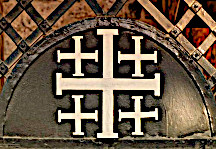
On Tuesday, July 15, 1099 A.D. Christian combatants of the First Crusade conquered Jerusalem, killed its Jewish and Muslim inhabitants and inaugurated the Kingdom of Jerusalem. One week later the crusaders chose Godfrey of Bouillon to rule over their new kingdom, but out of respect for the kingship of Jesus, Bouillon instead preferred the title, “Defender of the Holy Sepulcher,” a reference to the church that marks the traditional location of both the crucifixion and burial of Jesus. At that time the crusaders also adopted a symbol for their kingdom, known to most as either the Crusader cross or the Jerusalem cross, which has become a popular symbol for Christianity in general, especially within Roman Catholicism.

Most modern representations of a Christian cross are drawn with a vertical stroke that’s longer than its horizontal stroke and with the horizontal stroke placed at the upper end of the vertical stroke whereas a Jerusalem cross is drawn with strokes of equal length that intersect at their midpoints. Altogether the latter uses five crosses—one central cross and four smaller crosses positioned inside the four quadrants formed by the central cross. Additionally the arms of the central cross are drawn with small crossbeams at each end, but you will see many stylistic differences.

According to various traditions, the central cross represents either Jerusalem or Jesus; the four smaller crosses represent the four disciples or the four corners of the world; and the five crosses in total represent the five wounds of Jesus—two in his hands, two in his feet and one in his side. Do you like the design of the Jerusalem Cross? Would you consider having one tattooed on your hand or right wrist as is quite popular with Coptic Christians after having made their pilgrimage from Egypt to Jerusalem?

Daniel McCabe

On Location:: Artistic Locations in Israel

I have seen a lot of beautiful art throughout the country. Much of it was made by God himself in nature. I think of places like the Sea of Galilee, the unique wonder of the Dead Sea, the wildlife of the Hula Valley and many other beautiful forests, deserts and mountains.

I have also seen many great works of human art in several churches. One that I think of often is a recent construction, that of the church in Magdala on the western shore of the Sea of Galilee. Magdala is an ancient fishing village, the hometown of Mary Magdalene. A church was built there in 2014 called the Duc in Altum, which is a Latin phrase taken from Luke 5:4, where Jesus told Peter to “put out into the deep” and in obedience Peter cast his fishing net into the deep water and caught a surprising number of fish after having caught nothing all night long.

The architecture of the church itself is impressive, yet not overstated. There are three areas within the church that stick out to me. You first enter the Women’s Atrium, which commemorates women of faith throughout the ages. Seven pillars bear the names of women connected with Jesus’ ministry and an eighth is deliberately left blank to symbolize all women of faith. It is really fun to sing inside the atrium because its domed roof does wonders with the acoustics as the sound reverberates all around you.

You can then walk from the Women’s Atrium into a light and airy modern church sanctuary, the Boat Chapel, named for its pulpit, which is shaped like an ancient fishing boat. When you sit on one of the benches, facing the boat pulpit, you see the waters of Galilee beyond the large glass wall behind the boat, and your eye level is such that it looks as if the boat is floating on the Sea, just like Peter’s did two thousand years ago. That visual is artistic enough, but when you look around the room you will also see banners of Jesus’ twelve apostles. Eleven of them feature something that the twelfth does not—a halo! The one without a halo is none other than Judas Iscariot who was not saved and redeemed from his sins.

But for me the most significant piece of artwork in the entire church is found in the basement. Underneath the Boat Chapel is a room called the Encounter Chapel. When you walk into this room you come face to face with a large mural that always takes my breath. Although the painting captures a busy street scene, you can only see the feet of the people. There are some in sandals and Roman boots, but in the middle of the mural you see one notable person’s feet—those of Jesus. What is remarkably different from everyone else’ feet is the lone hand reaching out to touch the feet of Jesus, for the town of Magdala is a possible location of a well-known biblical miracle, one that I must confess to tearing up every time I read it. It is one of only a few passages in the Gospels that always has this effect on me. Each synoptic Gospel records the story of a woman who suffered form an issue of blood for twelve years without relief, yet her condition only grew worse even though in desperation she had spent everything she had on help from local physicians. Her impressive faith and humility now brought her to Jesus who healed her with great power and compassion. The mural in the Encounter Chapel captures this moment well, and that alone is worth your time to make a visit to the Duc in Altum in Magdala.

Adam Keim

From the Archives: The Millennial Temple

Six times in seven verses the Apostle John describes a future, 1000-year period of time during which Jesus will reign physically on the earth (Revelation 20:1-7). Just imagine! The Bible says a great deal about conditions during this coming age, including longer life spans, worldwide peace, the transformation of animal life, and even blooming deserts, but for now we’ll focus only on temple worship during the Millennium.

The prophet Isaiah predicted that “in the latter days … all nations shall flow to [the LORD’s house, the millennial temple]” (Isaiah 2:2). The prophet Haggai likewise predicted that all nations will come to this temple, adding that it will be more glorious than any temple the Jews had ever seen (Haggai 2:7-9). Ezekiel spent several chapters in his prophecy, describing in detail the dimensions, parts and contents of this beautiful, last days temple (Ezekiel 40-48; cf. Isaiah 60:13) as well as the obligation of those living at the time “to keep its whole design and all its ordinances, and [to] perform them” (Ezekiel 43:11), including required animal sacrifices and pilgrimages (Isaiah 56:7; Jeremiah 33:18; Zechariah 14:16-19).

The Old Testament sacrifices described in the Law of Moses were never prescribed as a cure for sin, but rather to point the worshipper to his sin with the subsequent hope of a coming Deliverer who alone could take away his sin (Hebrews 10:4). Likewise, the sacrifices prescribed during the Millennium will point to Jesus, “the Lamb of God,” who provided sin’s cure at Golgotha and now reigns as king (John 1:29).

The massive millennial temple and its courts will cover about one square mile of land, marked by a tree-lined, healing stream that will emanate from the threshold of the temple (Ezekiel 47:1, 7). There is no mention of the ark of the covenant, a veil, cherubim or even a high priest in the millennial temple, but the glory of God will return to it, for Israel has returned to her God after a prolonged period of unbelief, and he “will dwell in their midst forever” (43:2, 9).

Daniel McCabe

Answer to the Trivia

D. Zechariah

“Watch, Stand, Love!”

January 10, 2026

Yesterday I discussed the church that met in the house of Stephanas, how they “addicted themselves to the ministry of the saints” (I Corinthians 16:15).

Today, we’ll move back just two verses in this letter, to Paul’s admonition:

Watch ye, stand fast in the faith, quit ye like men, be strong. Let all things be done with charity.”

–I Cor 16:13-14

The 1607 King James’ version of the Bible is beautiful, but sometimes that 400-year old translation uses words that leave us confused. But we shouldn’t have trouble with the first two phrases:

I. “Watch Ye”

“Watch ye” is really a multi-faceted jewel that warns us to use our eyes to constantly examine the world around us, and to carefully consider the circumstances that impact our lives. But it also cautions us to keep our spiritual eyes on the shifting sands of the world’s moral values, and protect them from the winds of perversity that threaten to blind us, sweep us off our feet, and even bury us in deep dunes of sin. But apart from the dangers of succumbing to the siren sounds of this world, we are to be alert for the coming of our Lord and Savior, Jesus Christ.

Like the ten virtuous virgins, we are to keep ourselves pure, symbolized by having their lanterns filled with the oil of the Holy Spirit, and their wicks trimmed so that they might, at any moment, welcome the return of the Bridegroom. May he set us aflame with boldness to share the truth, knowledge, and grace of the Lord.

Watch ye” is an admonition that echoes Jesus’ warning:

“Behold, I send you forth as sheep in the midst of wolves: be ye therefore wise as serpents, and harmless as doves”

Matthew 10:16, KJV

We must each learn from the past, for as George Santayana so wisely remarked, “Those who don’t read history are doomed to repeat it.”

The apostle Paul shared this reflection, which seems to discourage our looking back:

“this one thing I do, forgetting those things which are behind, and reaching forth unto those things which are before, I press toward the mark for the prize of the high calling of God in Christ Jesus.

Philippians 3:13-14

Yet Paul did not completely forget the past, for he repeatedly mentioned his origins, and stated categorically that he was chief of sinners, and “…the least of all the saints.” I’m sure that Paul was thankful for these remembrances, however, both because it reminded him of the enormity of his deliverance from sin through faith in Christ, and provided opportunities to again consecrate himself—to make certain that his feet were solidly planted on the straight and narrow.

Often, in the dark of night, when my spiritual resistance is low, I am reminded of sins I’ve committed, both of omission and commission—unintentional and intentional—and while I may rebuke the enemy for temporarily depressing me in yet another effort to wreck my faith, I’m also reminded that God has a purpose in bringing these matters to mind. So as I pray to be delivered from each spiritual attack, I also thank God for reminding me of the depths to which I had sunk, and for the heights he had lifted me. Aand I am again reminded of the treacherous pitfalls of this world, not to speak of my proclivity to sin.

This leads me to paraphrase Santayana: “He who doesn’t read his own history is doomed to repeat it.”

Paul’s warning to the Corinthians was timely, for they were about to be misled by evil teachers:

Watch ye….”

II. “Stand fast in the faith”

This is another phrase that, on its face, is easy for even the youngest believer to grasp, yet is rich in meaning.

Paul had already explained this concept in the preceding chapter.

“Therefore, my beloved brothers, be steadfast, immovable, always abounding in the work of the Lord, knowing that your toil in the Lord is not in vain.”

I Corinthians 15:58

“Stand fast!” Be steadfast, immovable.

We are not to be shaken or moved by the events around us, nor moved by what happens to us.

III. “Quit you like men”

No, that phrase doesn’t imply that you, or any Christian, should quit when the going gets touch. Quite the contrary. The word is a root the the word “acquit,” which means to conduct ourselves properly.

When the Israelite army, under King Saul, quaked in fear at the daily appearance of the giant, Goliath, young David stood fearlessly before him, and acquitted himself as a man, demanding of Goliath how he dared mock God, and declaring his certain death. Which leads to the next phrase:

IV. “Be strong”

And, again, we can look to the young shepherd poet, the future warrior king of Israel, to young David–who gained godly confidence when he fearlessly slew both bear and lion—and who would use that strength to cast the stone that killed the ogre, Goliath.

And then Paul exhorts:

V. “Let all things be done with charity.”

“Let all things be done with charity,” or, more succinctly, “with love.” Our motives must always be to build up those around us, to protect, encourage, and even lift their burdens, even to do good to those who despitefully use us.

Is there ever an occasion when a Christian might injure or even kill another person? David didn’t hesitate to kill the reprobate, Goliath, who proved his own merciless and evil nature by slaughtering those he opposed, and by mocking the Lord and threatening the very existence of the nation of Israel.

David’s hands were clearly guided by God to take immediate judgment on Goliath and the army he championed.

Look at this seeming contradiction. In the night in which Jesus was betrayed, as he and his disciples were about to leave the upper room for the Garden of Gethsemane, Jesus said,

“…he that hath no sword, let him sell his garment, and buy one. For I say unto you, that this that is written must yet be accomplished in me, And he was reckoned among the transgressors: for the things concerning me have an end.” And they said, “Lord, behold, here are two swords.” And he said unto them, “It is enough.”

Luke 22:35

Why did Jesus tell his eleven disciples—common laborers who had little knowledge or skill with weapons—to buy swords​? It seems curious that just a few hours later, Jesus admonished Peter for using a sword to cut of the ear of Malchus, a servant of the high priest, and commanded Peter to put away his sword. Jesus’ words to Peter, followed by his miraculous healing of the man’s ear, along with his earlier statement that “…that is written must yet be accomplished in me,” makes clear that Jesus did not want to resist Judas and the multitude that accompanied him when they came to arrest him.

So what was the point in Jesus emphatically stating that they should buy swords, even if it meant selling their garments to buy them? That too was related to up in his words, “… this that is written must yet be accomplished in me, … for the things concerning me have an end.” The point was that, if they were attacked by anyone—malcontents, brigands or thieves—on their way to his arrest, they were to use those swords to fight back, to make certain that nothing interrupted his appointed trial and crucifixion. His passion was the thing yet to be accomplished in him. Once being arrested, however, there was no more need for swords. They haad been needed only for self-defense!

The words of Ecclesiastes provide a beautiful illustration of this seeming paradox:

“To everything there is a season…A time to kill and a time to heal.”

Ecclesiastes 3:3

Jesus gave license to his disciples to defend against anyone who might hinder him from his appointed destiny, and when there was no longer a need for the sword, and his arrest was certain, Jesus turned around and healed the man who was despitefully using him.

I’ve spent a lot of time discussing Paul’s final exhortations in his first letter to the church at Corinth. Some of his words would seem harsh to young Christians in a vile pagan city. And considering how Paul had rebuked the Corinthian Christians earlier in the letter for their sinful behavior, it’s little wonder that some in that church would, during Paul’s absence, begin to mock him.

We learn from Paul’s next letter—the one which we call II Corinthians, that during the interim between the two letters—that false teachers had crept in, evil men who mocked Paul, who questioned his apostleship and the validity of his words, and who sought to poison the Corinthians against him and his authority.

So II Corinthians becomes an apologetic. It’s largely Paul’s defense against these people and their attacks, making II Corinthians perhaps the most defensive book in the Bible.

Ironically, When Paul wrote the second letter, he would find himself required to obey the words that he had written under the inspiration of the Holy Spirit at the end of jos first letter. You know the words:

Watch ye, stand fast in the faith, quit you like men, be strong.”

And, most importantly,

“Let all your things be done with charity.”

___________________

Copyright 2026, Frank Becker

File: 10 JAN 26, Watch, Stand, Love

THE GREAT LIGHT

Week Two, 2026

“Those who walked in the dark have seen a bright light. And it shines upon everyone who lives in the land of darkest shadows” (Isaiah 9:2).

It is something I try to do at least once every year: go hear the words and music of Handel’s Messiah. Written in just twenty-four days with thousands of notes and words, it depicts the totality of the life of Christ, from prophecy until the resurrection.

It is especially rewarding when the written script of words is displayed behind the orchestra. Each time, it seems that I find a new nugget, and this year was no exception. There it was, Isaiah 9:2: “The people walking in darkness have seen a great light; on those living in the land of the shadow of death, a light has dawned.”

It was the prophecy of salvation. We are all sinful creatures who walk through life as sinners in darkness until we see and accept the light of Jesus as our Lord and Savior. It is truly the great light.

Isaiah 9:2 is a prophetic verse about a great light shining on those living in darkness, often interpreted as a promise of hope and salvation significantly fulfilled in the birth of Jesus Christ. The “darkness” symbolizes oppression, despair, and spiritual ignorance, while the “light” represents the hope and joy brought by the arrival of a Savior. The verse foretells a turning point where light breaks through gloom, offering both immediate encouragement and a lasting message of salvation. It truly is the great light.

Then I saw another nugget: “By His stripes we are healed.” This is a powerful biblical phrase from Isaiah 53:5, signifying that the suffering, wounds, and punishment Jesus Christ endured (His “stripes”) provide spiritual and physical healing, redemption, and peace for believers, as echoed in 1 Peter 2:24. It speaks to the profound sacrifice of the Messiah, who bore humanity’s sins and ailments so that people could be made whole.

And then, after going through the life of Christ, the question is asked: “Who is the God of glory?” This is a title for the one, transcendent God of the Bible, emphasizing His majestic splendor, power, and honor. Jesus Christ is identified as the embodiment of this glory in the New Testament, revealing God’s perfect nature, grace, and truth to humanity.

Then it ends, and the audience leaves to ponder who is their God of glory. I ask each of you who read this: Who is your God of glory?

Sometimes True Stories

Equating what we do with who we are, our performance with our identity, is not a worldview unique to many people. We are made with a “God-shaped emptiness,” to paraphrase Blaise Pascal. But if secularized people do not turn to God, they will turn to anything else to fill the void. For many in a materialistic culture, our gods are therefore material measures of success such as performance, possessions, and popularity.

Accordingly, perhaps we should not be surprised that Gallup is now reporting the current “drop in US religiosity” as “among [the] largest in the world.” In 2015, 66 percent of US adults said religion was an important part of their daily life. Today, only 49 percent agree. This seventeen-point drop “ranks among the largest Gallup has recorded in any country over any ten-year period since 2007.” —Jim Denison

– 0 –

Jesus looked at them and said, “With man this is impossible, but with God all things are possible” (Matthew 19:26).

– 0 –

What do you think of when you see the word trustworthy? Someone you can rely on, someone honest, truthful, and dependable. These are all character traits we should endeavor to possess. When we receive trustworthy behavior from someone, it boosts our spirits and refreshes our soul. When we find such a person, we are blessed; if we can become that person, God will bless us.

Quotes You Can Use

If Christ provides only a part of our salvation, leaving us to provide the rest, then we are still hopeless under the load of sin. —J. Gresham Machen

You are only as powerful as you are weak in your own strength. —John MacArthur

The meaning of life is to find your gift. The purpose of life is to give it away.

The Holy Spirit’s main ministry is not to give thrills, but to create in us Christlike character. —J.I. Packer

If you can’t sleep, then get up and do something instead of lying there worrying. It’s the worrying that gets you, not the lack of sleep. —Dale Carnegie

God created everything by number, weight, and measure. —Isaac Newton

My job is not to worry about tomorrow, but to trust Jesus today.

Jesus, who died on the cross stands by you today.

Jesus knows what I am facing today.

The Lord stands by His people: through their persecution, through the words of His promise, and through the protection of His servant. Trust that the Lord Jesus is by you; be faithful where you are. —Edgar Aponte

Pride is the mother hen under which all other sins are hatched. —C.S. Lewis

Gratitude is never silent. People who are truly thankful for the Lord’s healing will always express it. Give thanks to God openly and often. —Zach Jernigan

Speech should be treated as though it were a loaded gun because we will be judged by what we do, as well as what we say. —Tony Ferguson

No man is too lost for Jesus to save, but no man is too good to escape hell.

Proverbs 8:33 says, “Listen to my instruction and be wise; do not ignore it.” This verse is not a suggestion, but a command from the Lord. Treat it with care. —Tony Ferguson

***

Your feedback is welcome. If you want to contribute your ideas and thoughts, address all items and comments to [email protected].

©Thoughts on Life Copyright 2026

The Pharaoh of the Exodus

View Post

January 3, 2026

The Pharaoh’s Name, part 1

His name is Rameses II, according to the classic 1956 movie, The Ten Commandments, starring Charlton Heston as Moses and Yul Brynner as the pharaoh. In fact, movies, documentaries and history books almost universally concur. But there are massive problems with this view. Let’s take a deeper dive.

Egyptian history is arranged into a series of dynasties, and for reference I’ll refer to a chart of the reigns of the pharaohs given in the first edition of Cambridge Ancient History, a respected secular source. The biblical date for the exodus is 1446 B.C., according to 1 Kings 6:1, but most secular historians date it to around 1270-1250 B.C. The biblical date falls into the period of the eighteenth dynasty (1570-1320) and the later date falls into the period of the nineteenth dynasty (1320-1223).

To begin our hunt for the pharaoh of the exodus we must remember that Moses fled Egypt under one pharaoh and returned forty years later only after that pharaoh died (Exodus 4:19), so we’re looking for a pharaoh in either one of the two dynasties who reigned for at least forty years. Turns out that there are only two—Thutmose III (1504-1450) and Rameses II (1304-1236). Aha! There’s the name Rameses! But wait! Thutmose III and Rameses II are the only two possibilities for the “oppression” pharaoh from whom Moses fled. The “exodus” pharaoh is not the “oppression” pharaoh whose death prompted Moses’ return to Egypt. The “exodus” pharaoh succeeded the “oppression” pharaoh. Therefore, the “exodus” pharaoh must be either Amenhotep II (1450-1425) or Merneptah (1236-1223). The “exodus” pharaoh cannot be Rameses II, for he would have died before Moses returned! I’d say that’s a pretty good reason to eliminate Rameses II from the running.

Three other quick points can be made in favor of Amenhotep II. First, most of the pharaohs of the eighteenth dynasty generally resided in Thebes, far south of the land of Goshen in the Egyptian Delta where the Israelites were enslaved, but Amenhotep II reigned regularly from Memphis (only around 75 miles from Goshen) and would have been readily accessible to Moses and Aaron.

Second, Josephus, a first-century Jewish historian, records the words of Manetho, a third-century B.C. historian, who wrote a history of his native Egypt in the Greek language, based on his study of ancient Egyptian records. Although Manetho’s works didn’t survive, Josephus refers to them, noting that Manetho gave the name of the pharaoh of the exodus as Amenophis, the Greek spelling of Amenhotep.

Third, Amenhotep II’s successor to the throne was not his firstborn son, but rather a younger son named Thutmose IV, which gives credence to the biblical account of the premature death of the exodus pharaoh’s firstborn son. We’ll look at this pharaoh and his boy next time in a post that you simply won’t want to miss!

Daniel McCabe

Trivia

Which Israeli city is considered one of the oldest continuously inhabited cities in the world?

A. Tel Aviv

B. Haifa

C. Beersheba

D. Jericho

Answer to the Trivia

D. Jericho